Bin rental or junk removal
Bin rental or junk removal?
Two ways to make a pile of stuff disappear, and they are different purchases with different economics. Big Bin sells one of them, which is worth knowing before you read the rest — including the part where the other one wins.
- 5-Star Rated
- No distance charge
- 7 days included
- Order by 3PM, next-day delivery
Quick answer
Should I rent a bin or hire junk removal?
Rent a bin if you have the people and the time to load it, and hire junk removal if you do not — that is the whole decision, and everything else is detail. A bin is a container dropped at your place, filled by you at your own pace, and taken away when you are done. Junk removal is a crew who arrive, carry it out and leave the same day, priced by how much they take and how long it takes. Big Bin — our company — rents bins and does not do junk removal, and there are jobs below where the crew is the better buy.
The two options, side by side
- What each one is
- A bin is a container you fill. Junk removal is people who load it for you and leave with it
- Who does the loading
- You or your crew for a bin. Theirs for junk removal — that is the thing you are paying for
- How each is priced
- A bin on the container and the days, plus the weight at the scale on a mixed load. Junk removal on the space it fills and the labour
- How long each takes
- A bin stays as long as the job needs. Junk removal is usually one visit
- A one-off clear-out with no driveway
- Junk removal, almost always. A container needs somewhere legal and level to stand
- What Big Bin does
- Rents bins. It does not send a crew, carry anything out of a building, or price by volume
What does each one actually cost you?
There is no like-for-like number, and anybody who gives you one is comparing two different things.
They are priced on different quantities. A bin bill is built from a container, a number of days and — on a mixed load — a reading off a weighbridge. The other is built from how much room your things take up on a truck, and how many hours it takes to move them.
So the two bills are built from different raw materials. A mixed-waste bin scales with weight, and junk removal scales with volume and labour — which is why the same pile can be cheap on one and expensive on the other, in either direction.
A wardrobe, a mattress and a broken treadmill take up a lot of truck and weigh very little. A ton of tile and plaster from a bathroom is the reverse: compact and heavy. On the first, paying by volume hurts and paying by weight is kind. On the second it is exactly the other way round.
The comparison people usually skip is their own time. A container is cheaper on paper and it is not free — it costs you a weekend, a bad back, and the favour you have to call in. That is a real cost and it belongs in the arithmetic even though nobody invoices you for it.
Treat any junk-removal figure you find quoted second-hand as worthless: it will be somebody else’s, from a date nobody recorded, for a job nothing like yours. Ask the company that would be doing the work. How a bin price is built is on What a bin costs, and Get a quote gives the figure for your own job.
| Option | What you are buying | Who loads it | What sets the price | How long it takes | Best for |
|---|---|---|---|---|---|
| Junk removal | Labour. People who arrive, carry it out and take it with them | They do | How much space it fills on their truck, and how long it takes to move | Usually one visit, often same day | One awkward item, a clear-out with nowhere to put a container, or a job where nobody can do the lifting |
| Bin rental | A container, two truck trips, and the disposal | You do, or whoever is already on site | The container and the days, plus the weight at the scale on a mixed load | As long as you keep it — days or weeks | Work that runs over days, anything heavy, and any job where the people are already there |
The part nobody counts: who does the lifting
A bin is filled by you rather than by the driver, and what that involves in practice is the variable that decides most of these jobs.
It means somebody handles every single item twice. Once to get it out of the room, and once to get it over the side of a container or through its back door. Between those two moments there is usually a staircase, a hallway, a doorway that is narrower than the thing, and a stretch of lawn or gravel.
None of that is difficult on a site where four trades are already working. Somebody is carrying material out anyway, the bin is ten steps from the door, and clearing as you go is simply part of the job.
It is a completely different proposition for one person clearing out a parent’s house. The furniture is heavier than it looks, and there is more of it than the rooms suggested. The person doing it is often in no state, physical or emotional, to spend a weekend on it.
So the useful question is not which service is cheaper. It is whether you have the bodies — and if the honest answer is no, then the cheaper option on paper is the one that does not get finished.
What handling a container involves once it is on the ground, including the back door most people do not know is there, is on Roll-off bins explained.
When junk removal is the right answer
There are jobs where renting a bin is the wrong call. Here they are.
One item. A single sofa, a fridge, a mattress, a treadmill. Ordering a container for one object is absurd. Two people with a truck will have it gone in ten minutes.
A clear-out with nowhere to put a container. An apartment, a condo, a downtown house with no driveway and a street you would need permission to occupy. A bin has to stand somewhere legal and level for days. If that place does not exist, the decision has been made for you.
An estate clearance where nobody can do the lifting. This is the most common version and the least talked about — a house full of forty years of things, and the people responsible for it are grieving, elderly, or three provinces away. Paying somebody to carry it out is not a luxury there.
Anything that has to be gone today. A container has to be delivered before it can be filled and collected after. A crew can be finished in an afternoon.
And any job where the item is the problem rather than the volume — something too heavy for two people, or awkward enough that getting it down a staircase is the entire task.
If your job is on that list, Big Bin is the wrong call and a junk-removal company is the right one.

What our customers say
From our Google Business Profile, read on 2026-09-16
I would like to shout out these guys! Finding a waste disposal company that handles heavy materials like concrete without a bunch of hidden fees or headaches is usually very difficult but Big Bin made the process very easy. Pricing was great and the team was very professional. I would genuinely recommend them for any big project!
Ayman Khaled On time, quick and easy to communicate with, and great service all around
Eldin Malkic Amazing work ! Very good time that takes good care of you !
Evgeny Litvinenko
When a bin is the right answer
A container wins whenever the work runs longer than a visit, or the material is heavier than it looks.
A renovation is the clearest case. Debris arrives over days or weeks rather than all at once. Having somewhere to put it as you go is most of the value: you are buying a place to throw things while the work runs, not a single collection.
Heavy material is the other clear case, and here the pricing works actively in your favour. Junk removal charges for the space something occupies. Dense material occupies very little of it, while being the most expensive thing to dispose of. A bathroom’s worth of tile, mortar and plaster is a small heap and a large tonnage: the Minnesota Pollution Control Agency puts a cubic yard of mixed renovation debris between 323 and 838 pounds. Broken concrete runs far heavier again. What does your debris weigh? turns that into a tonnage. A bin takes rubble as one flat haul at a single figure; junk removal charges for truck space the same material barely fills.
There is a ceiling on that, and it belongs to the truck rather than the container. Dense material runs out of permitted weight while the container still looks half empty. Commercial bin and dumpster rental works through where that limit comes from, and Concrete disposal does the arithmetic for a slab.
A job with people already on it is the third case, and the simplest. If trades are working, somebody is carrying material out of that building today whether or not you rent anything. Paying a second set of people to do the same carrying is paying twice.
And a container puts the timeline in your hands rather than a crew’s. You fill it at the pace the work actually goes, which is rarely the pace a booking form assumes. Which size suits the job is on Bin size guide. The stage-by-stage version is on Construction bin rental. Whether the address is one we reach is on Bin rental near you.
If that sounds like your job
The size guide answers which container fits it, and a quote turns that into a figure. Neither wants an email address.
The mixed answer most people miss
The two are not exclusive, and treating the choice as either-or is what makes some of these jobs expensive.
The mixed approach is a crew for the awkward things and a container for the bulk. Somebody takes the piano, the chest freezer and the two wardrobes that will not come down the stairs intact. Everything else goes into a bin over the following week, at whatever pace you manage — the boxes, the carpet, the cupboard contents, the endless bags.
That is frequently cheaper than either option on its own. You are not paying labour rates to move things you could carry yourself, and you are not spending a Saturday failing to get a freezer through a doorway.
It is also what people in the trade already do without thinking of it as a strategy. A demolition crew will hire specialists for the one thing they cannot handle and put everything else in the container that is already on site.
Split the work and you will rent a smaller container than you otherwise would, or keep it for fewer days. Either is worth having.
On a working site the split is usually obvious once somebody says it out loud — Construction bin rental covers how a build’s waste changes as it goes. Get a quote prices the container half.
What Big Bin does not do
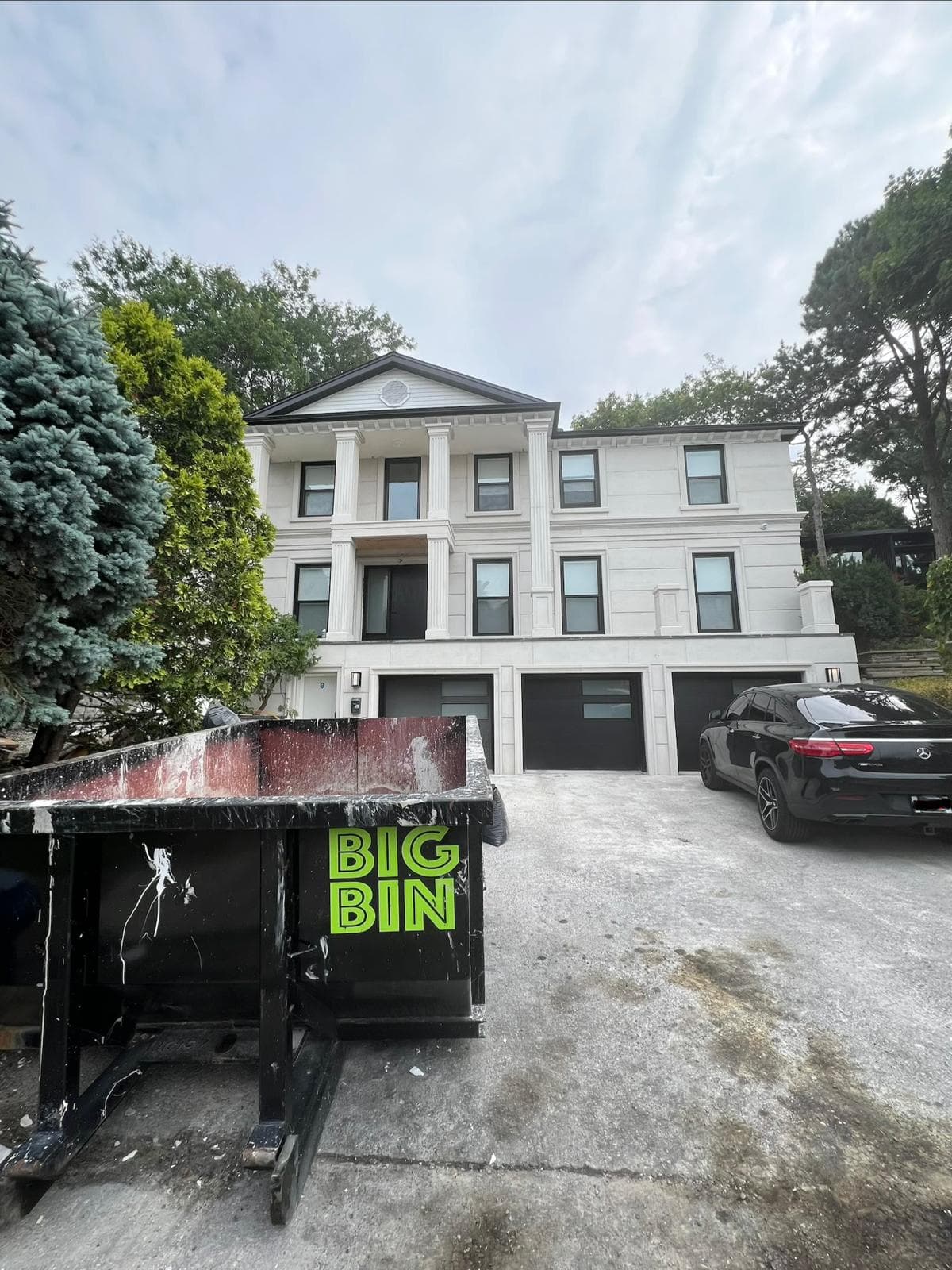
Big Bin rents containers. It does not send a crew, it does not carry anything out of a building, and it does not price by volume.
Nobody will arrive to help you load, and nobody should turn up expecting it.
There is a second limit worth knowing about, and it is published rather than left vague. Some things are not right for a container even when the job is otherwise a bin job — and mostly that is not the hauler’s rule at all. A regional waste site runs paint, solvents, batteries, propane cylinders, tires and electronics on streams of their own, each with its own limit or its own refusal, and asbestos is either refused outright or taken only by prior arrangement. A crew loading a truck for you sorts that at the kerb; a container makes it your call before the lid of the load goes on.
If what you need is the other service, look for it by category. We will not point you at a particular firm.
The vocabulary trips people up too, since "dumpster" and "bin" name the same container — Dumpster rental covers that. To ask whether a particular job suits a container at all, Contact Big Bin. The full list of what a mixed container takes, and what it does not, is on Roll-off bin rental.
01
Tell us about the job
Call or email with what you are clearing, where a container can stand, and when you need it.
02
The bin arrives
A truck sets the container where you asked. Nothing is tipped on site: you or your crew fill it, on your own schedule.
03
It leaves full
The truck takes the whole container away, and the load crosses a scale at the receiving site.
Decided on a bin? The next question is which size
Every size people search for, whether it exists here, and the nearest one that does when it does not. Once a container is the answer, size is the question that decides the cost.
Questions about the two options
Is junk removal cheaper than renting a bin?
Sometimes, and it depends on what you are getting rid of rather than on how much of it there is. The two are priced on different quantities: a bin on the container, the days and — on a mixed load — the weight at the scale, junk removal on how much room your things take up on a truck and how long they take to move. Bulky light things — furniture, a mattress, an old treadmill — fill a truck and weigh nothing, so paying by volume hurts. Dense material like tile, plaster or broken concrete is the reverse. For a junk-removal figure, ask the company that would be doing the work — anything quoted second-hand is somebody else’s number, from a date nobody recorded.
Can I hire someone to load a bin I have rented?
Yes, and it is a common arrangement that gets overlooked. The container and the labour are two separate purchases, so nothing stops you renting one and hiring help for the other. That might be a couple of people for a day, or a crew for the two items that will not come down the stairs. It is often cheaper than paying a junk-removal rate for the whole job, because you are only buying labour for the part that actually needs it. Big Bin rents the container and does not supply the people.
Which is better for a single mattress or sofa?
Junk removal, almost every time. Ordering a container, waiting for delivery, putting one object in it and waiting for collection is a great deal of process for a single item. You would also be paying for a container that is essentially empty. Two people with a truck will have it gone in ten minutes. This is one of the clearest cases where a bin is the wrong purchase, and Big Bin is the wrong call for it.
Do I need a driveway to rent a bin?
You need somewhere legal and level for the container to stand for as long as you keep it, and a driveway is the usual answer. A private parking area or a suitable stretch of yard can work too. What you cannot do is put one on a public road without municipal permission, which is a separate application with a fee the city sets. If there is genuinely nowhere on the property to put a container, that decision has been made for you and a crew is the practical option.
Does Big Bin offer junk removal?
No. Big Bin rents containers and that is the whole of it — nobody arrives to help you load, nothing is carried out of a building, and there is no pricing by volume. If what your job needs is people rather than a container, you want a junk-removal company instead — look for one by category rather than asking us to name one.
Sources
Every fact on this page that is not simply how renting a bin works, and the public document it came from.
Source 1
Volume-to-Weight Conversions (document w-sw2-08)
Minnesota Pollution Control Agency — September 2021
Reviewed August 2026Kenan Sljoka
Also on this site
Free tool
Bin size guide
Useful things to read
Page
Get a quoteService area
Bin Rental in MississaugaService area
Bin Rental in BramptonService area
Bin Rental in OakvilleService area
Bin Rental in WhitbyService area
Bin Rental in OshawaService area
Bin Rental in PickeringService area
Bin Rental in Ajax
If the answer came out "bin"
Tell us what you are clearing and where a container can stand, and we will tell you which size suits it. You fill it, at your own pace. Get a quote takes a postal code, what you are clearing and your name and number, and gives you the price.