Roll-off bin rental
Bin Rental in OakvilleFrom $650, before HST
14 yard, 30 yard and 40 yard roll-off containers, dropped anywhere in Oakville by a truck that starts its day in Mississauga. Households, renovations, trades and turnovers. What you put in the container moves the price; where in town it lands moves only the drive.
- 5-Star Rated
- No distance charge
- 7 days included
- Order by 3PM, next-day delivery
Quick answer
Who rents roll-off bins in Oakville?
Big Bin — our company — brings roll-off containers into Oakville from one municipality east, working Old Oakville and the downtown streets around Navy, Randall and Reynolds, the lakeshore either side of Sixteen Mile Creek, and the newer subdivisions north of Dundas. Three sizes are on offer: 14, 30 and 40 yard. Delivery, collection and 7 days on site are what a rental buys. Distance does not enter the figure, and neither does a fuel surcharge, an environmental fee, an admin fee or a contract. Order by 3PM for next-day delivery. Get the number from the quote, or ring 416-458-4324.
Why rent from Big Bin
The number you are quoted is the number you pay
Every charge that can ever reach an invoice is listed and explained before you book, not discovered afterwards. Tax is shown inside the figure rather than added at the end.
The same price across the whole delivery area
A job at the far edge of where Big Bin delivers costs what one round the corner from the yard costs. Distance changes the drive, not the invoice.
Order by 3PM, and a bin can be there the next day
That is a cut-off rather than an average, so it is something you can plan a job around. Whether a bin can reach you the same day you ring depends on how full that day already is, and that is a question for the call.
7 days included, and no contract to sign
The rental is the job, not a schedule you are joining. Keep the container longer and the extra days are priced and named; nothing renews and nothing has to be cancelled.
A real price without phoning for it
Postal code, material, size and your dates, and the figure comes back with the tax already in it — priced for your own days rather than for a typical week.
Renting a bin in Oakville: the facts
- Rentals from
- $650, before HST
- Delivers to
- All of Oakville, lakefront to the north end of town
- Based in
- Mississauga, ON
- Bin sizes
- 14 yard · 30 yard · 40 yard
- Customers
- Residential and commercial
- Hours
- Monday to Friday, 6:00 am – 6:00 pm. Saturday, 9:00 am – 5:00 pm. Sunday, closed
- Phone
- 416-458-4324
- What a rental covers
- Delivery, collection and 7 days on site
- Weight on a mixed load
- An allowance that rises with the bin, then a rate per tonne at the scale
- Heavy material
- Clean concrete and clean fill go in the 14 yard, with no weight charge
- Getting a price
- Postal code, material and dates in the quote — about 30 seconds
- Mixed renovation waste
- Goes in the 14, 30 or 40 yard
- Clean concrete
- Goes in the 14 yard
- Soil or fill
- Goes in the 14 yard
- Not taken
- Asphalt is not a material Big Bin takes, in any bin size. Big Bin does not take contaminated soil. Clean soil and fill go in a 14 yard bin, wherever the job is.
- Bin on an Oakville road
- The Town issues a temporary street occupation permit and asks for ten business days
- Nearest public drop-off
- The Halton Waste Management Site, on Regional Road 25 in Milton
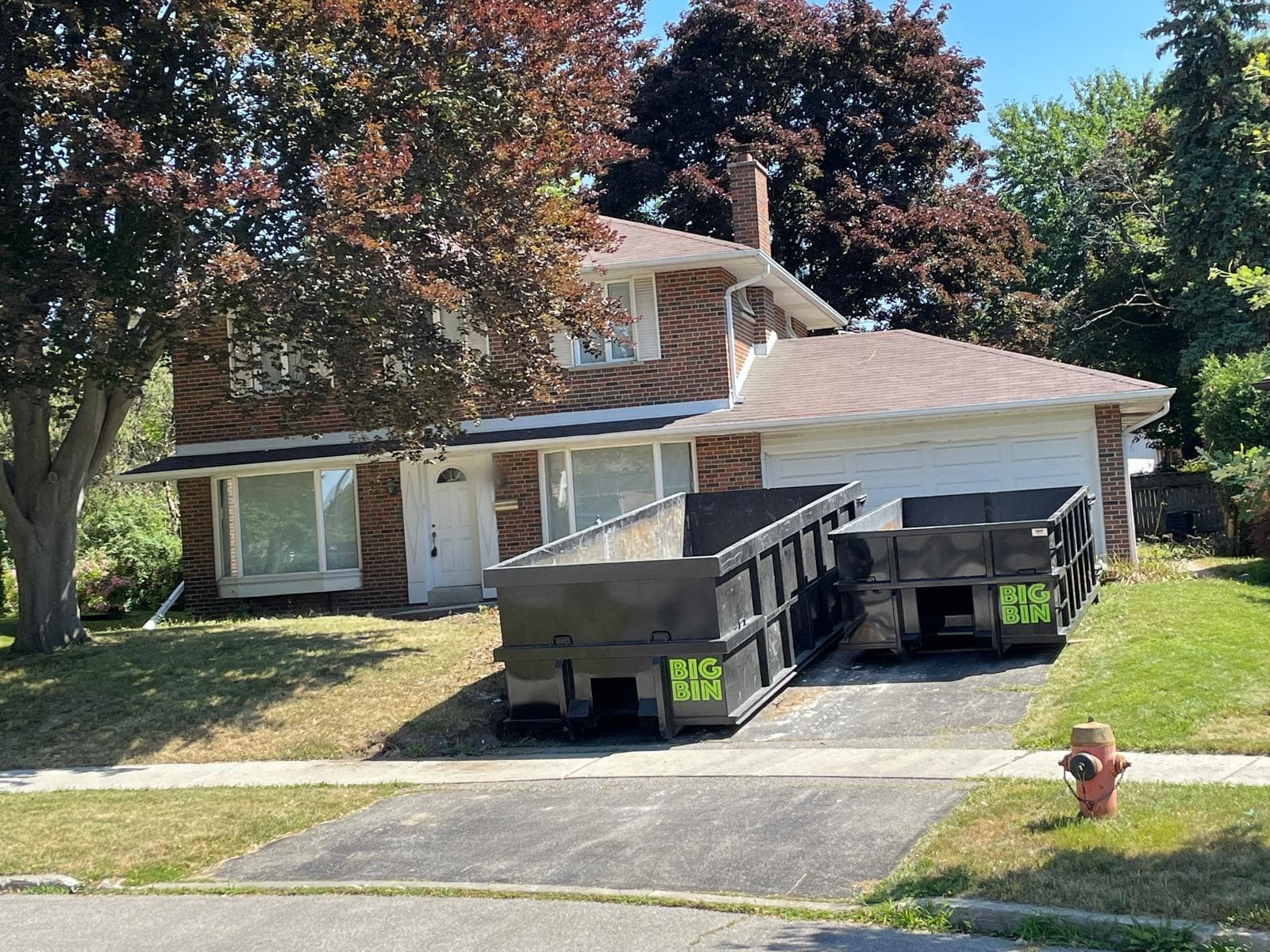
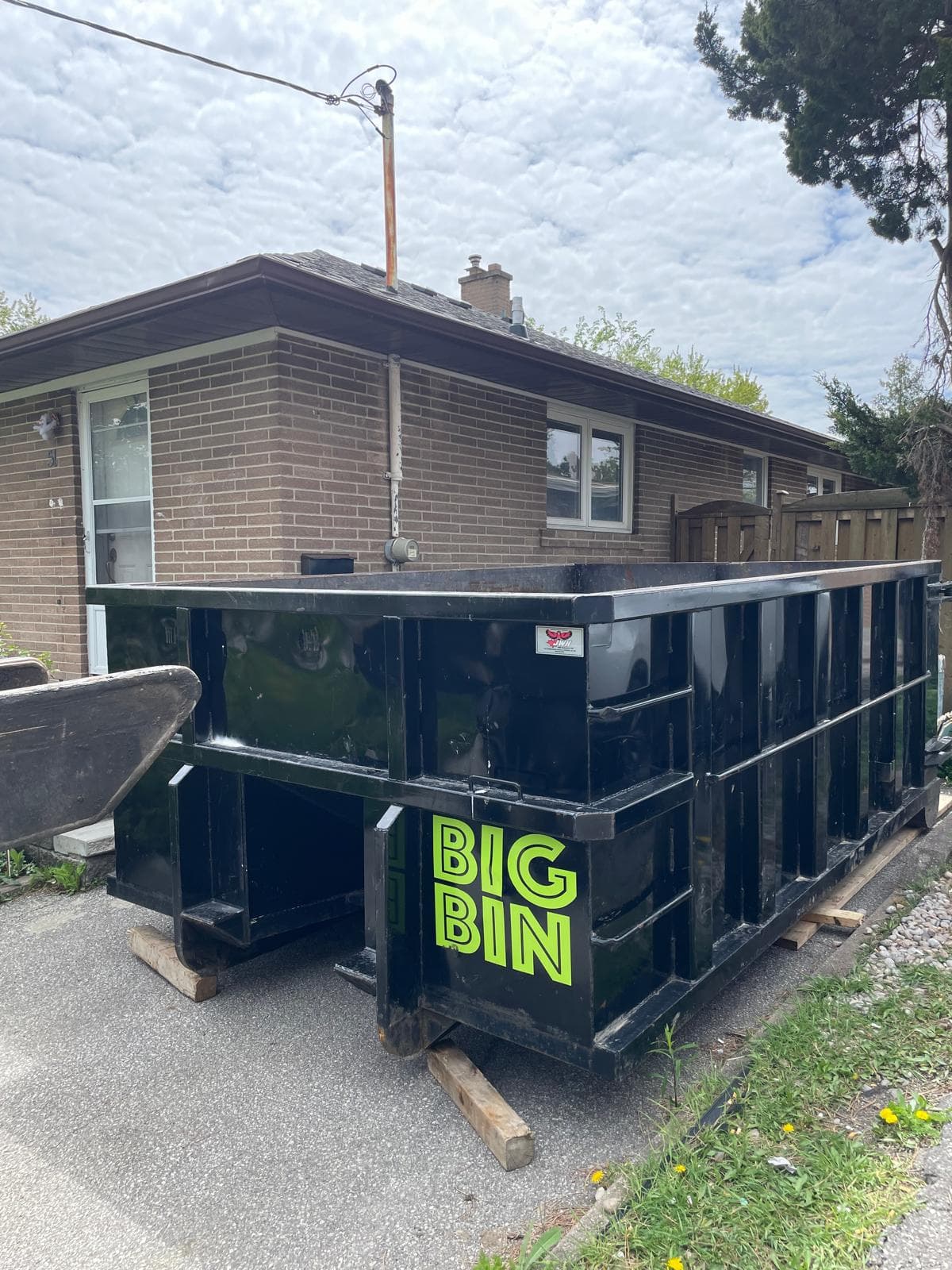
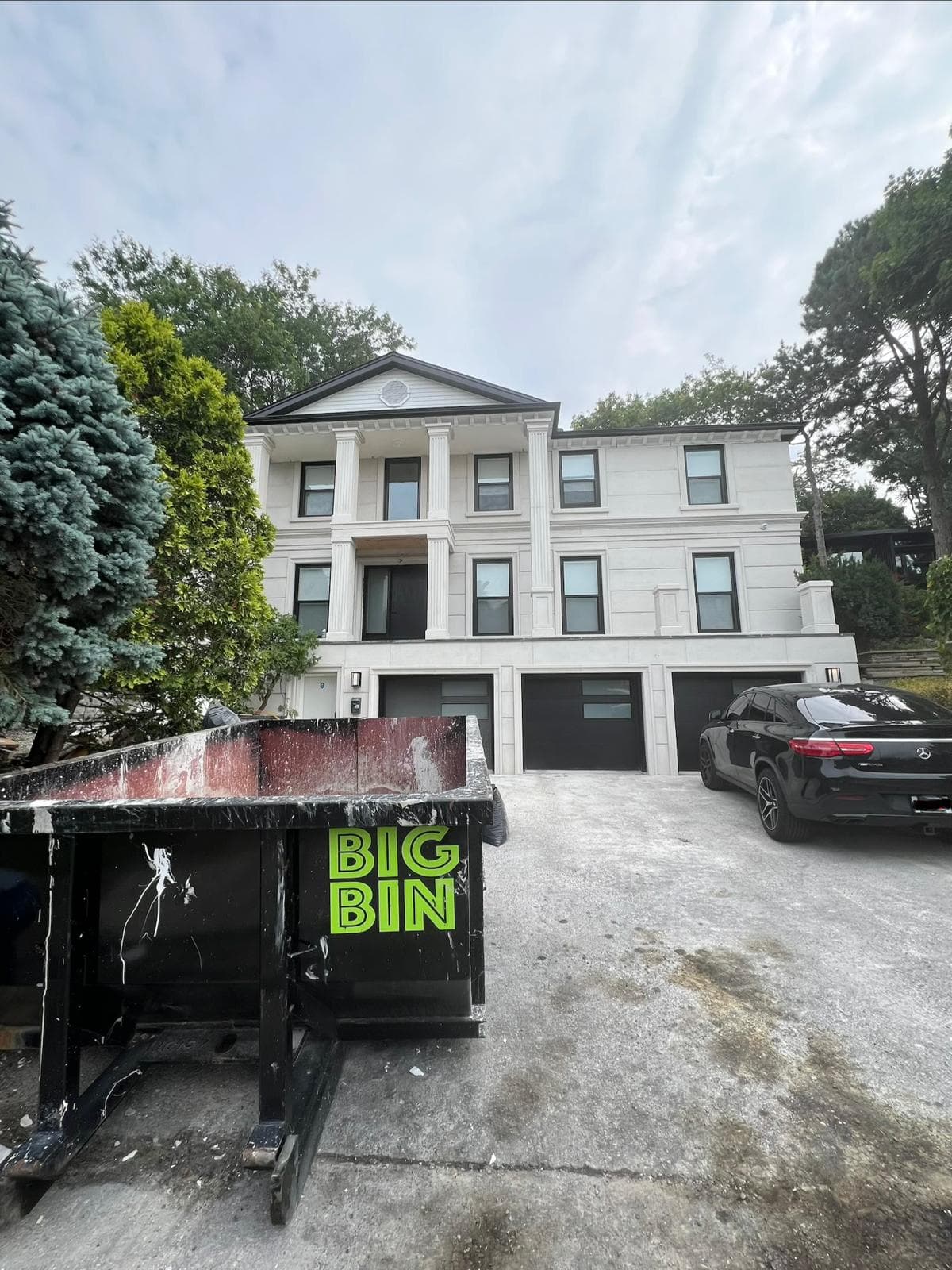
On the driveway, on planks
One of our own deliveries. The container is resting on wooden planks rather than directly on the driveway.
What Oakville customers say
From our Google Business Profile, read on 2026-09-16
I would like to shout out these guys! Finding a waste disposal company that handles heavy materials like concrete without a bunch of hidden fees or headaches is usually very difficult but Big Bin made the process very easy. Pricing was great and the team was very professional. I would genuinely recommend them for any big project!
Ayman Khaled On time, quick and easy to communicate with, and great service all around
Eldin Malkic Amazing work ! Very good time that takes good care of you !
Evgeny Litvinenko
Which government owns the road outside an Oakville address?
Two of them share Oakville, and not evenly. The Town of Oakville owns the overwhelming majority of streets in the town; Halton Region owns a numbered arterial network that runs through it. For most of what a household deals with the distinction never comes up. For a container that has to stand on the road it is the first thing to settle, because the two authorities run separate processes with separate paperwork and separate prices.
The Region states the division in the plainest possible terms on its own roads page: a problem on a Regional road goes to the Region, and a problem on a local road goes to the Town of Oakville. The Town states the other half of it in its by-law, by defining what its own authority covers — a municipal right of way is land owned by the Town as opened or unopened road allowances. Land the Town does not own is outside the reach of a Town permit, which is why the question has to be answered before the paperwork starts rather than after.
What neither government publishes is where a Regional road starts and stops inside Oakville. The Region numbers its arterials across all four of its municipalities rather than listing them town by town, and neither its numbering nor the Town’s own road records carry the from-and-to limits that would tell you which end of a street changes hands. So the name of the street will not settle it and nor will the look of it: a wide arterial through a subdivision can belong to either one, and a road can be the Region’s for part of its length. The Region keeps a map of its own network and answers the question on 311, and that is the check worth two minutes before a container is ordered for anywhere except a driveway.
The division above is how Oakville is organised rather than a stage in anything. Each of the two authorities administers its own road allowances, each publishes its own route for occupying one, and both of those routes are set out further down this page. Which of the two your block sits on is the only part left to establish, and it is the part worth establishing first.
| The question | Who answers it | Where it is written |
|---|---|---|
| A pothole or a sign on the block | Whichever of the two owns that road | The Region’s own roads page |
| Permission to stand something on the road allowance | The owner of that road allowance, and only for its own | Municipal Right of Way By-law 2024-002 |
| A container on your own driveway | Nobody — it is inside the property line | The by-law reaches Town-owned road allowance only |
| Which of the two owns this block | Halton Region, on 311 or its network map | Published without start-and-stop limits |
Not sure whether your block is the Town’s or the Region’s? Call 416-458-4324
What actually happens when a bin is delivered in Oakville?
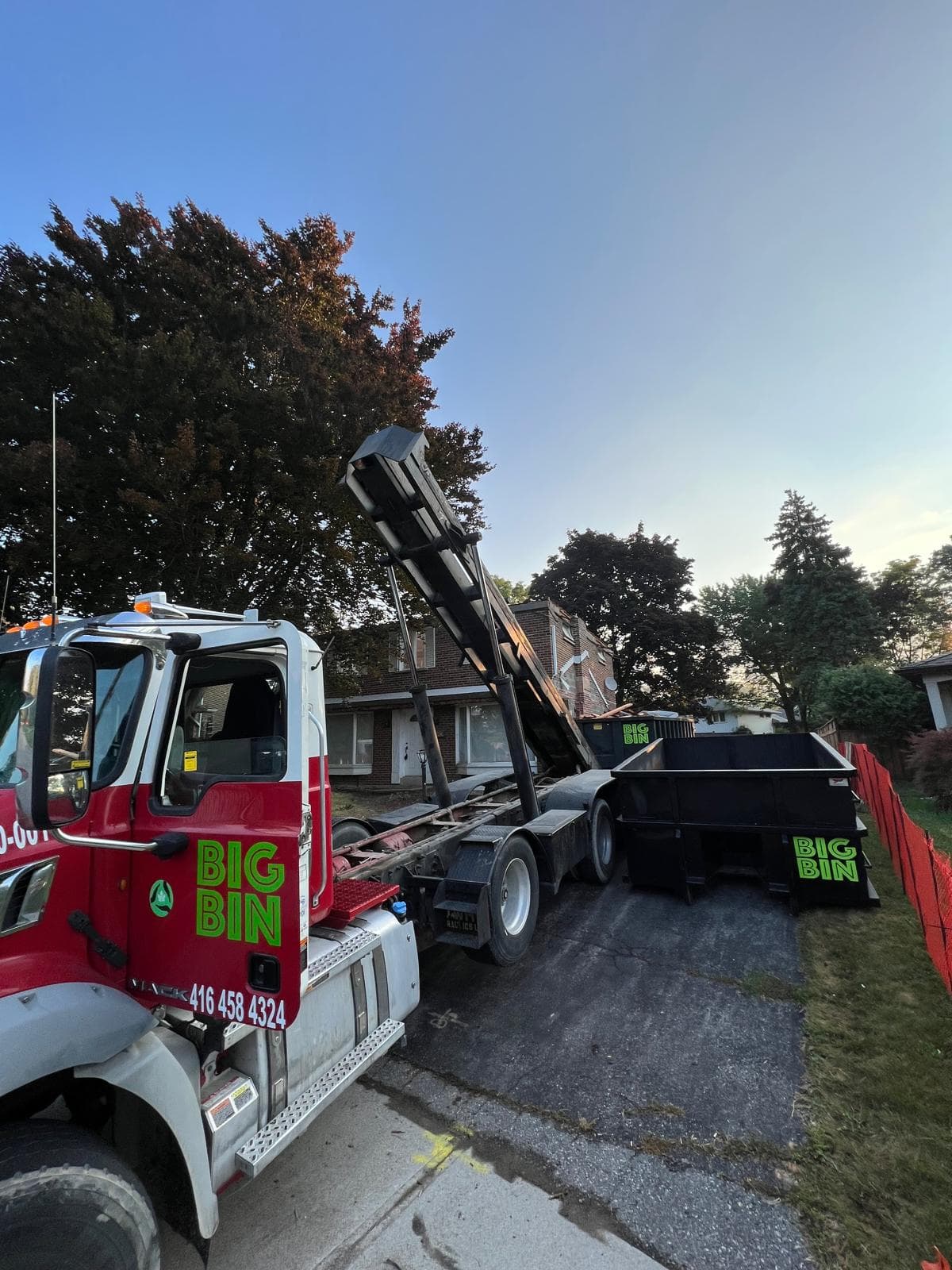
Three steps, and an Oakville customer needs to be present for none of them. Describe the job and say where the container can stand, a truck lowers it onto that spot, and later the same truck lifts it away with everything still inside. The load is never emptied out at the address.
The yard is in Mississauga rather than in Oakville — see Bin Rental in Mississauga, which is where the trucks start their day. Being one municipality away changes the length of the drive and nothing on the invoice. Ordering opens early: Monday to Friday, 6:00 am – 6:00 pm. Saturday, 9:00 am – 5:00 pm. Sunday, closed
West of here the same trucks reach the far side of the lake, and north of the yard the run turns inland at Bin Rental in Brampton. The long leg goes the other way entirely. It ends at Bin Rental in Oshawa, roughly as far east as the service goes, having already passed Bin Rental in Whitby on the way; the two towns before those, closer in along the same lake, are Bin Rental in Ajax and then Bin Rental in Pickering. All four answer to an upper tier that is not this one, so each keeps its own road list and its own permit counter. Strip the local half away and what is left is on Roll-off bin rental.
01
Tell us about the job
Call or email with what you are clearing, where a container can stand, and when you need it.
02
The bin arrives
A truck sets the container where you asked. Nothing is tipped on site: you or your crew fill it, on your own schedule.
03
It leaves full
The truck takes the whole container away, and the load crosses a scale at the receiving site.
Where does a bin stand at an Oakville address?
On the driveway, in almost every Oakville job, which is private ground and raises no permission question at all. Whether a given drive works is decided above it and behind it. The truck has to line up straight to reverse in, and the bed needs a lot of height above the container as it tips — Roll-off bins explained sets out the mechanism. So the things worth looking at are the hydro drop, the branches over the approach and the height of the garage soffit, rather than the length of the drive.
Where Oakville is unusual is that the Town has written the difference between its older half and its newer half into its own Official Plan, and written it as a measurement. Table 4 splits the local-road row at Dundas Street: south of Dundas the plan requires an 18 metre road allowance on a local street, and north of Dundas it requires the allowance to be minimised and to stop at 17 metres in residential areas, with kerbside parking on one side only. The rear lanes exist only in the northern row, at a minimum of 7.5 metres for a residential lane, and no on-street parking is permitted along one at all.
Read that as a rule of thumb the Town wrote down itself. It sets aside more public room on a local street south of Dundas Street than on one north of it, it holds kerbside parking to a single side north of Dundas while saying nothing about parking in the southern row, and on a lane it permits no on-street parking at all. A container has to stand somewhere and the truck placing it has to stand somewhere too, and the amount of public room the plan reserves for both is not the same on the two sides of that line.
The oldest part of the town concentrates the problem further. Oakville has four heritage conservation districts, and all four are in the same corner of it — Old Oakville, south of Robinson Street to the lakefront between Sixteen Mile Creek and Allan Street; First and Second Street, between Lakeshore Road East and the lake from Allan Street across to Second Street; the Trafalgar Road district, between Sixteen Mile Creek and Reynolds Street from Spruce Street down to Sumner Avenue; and Downtown Oakville, from just west of Navy Street to Dunn Street and from north of Randall Street to the south side of Lakeshore Road East. The Town dates that ground to an 1855 survey in one district and to houses largely built before 1860 in another, so the street layout there was set out a century and a half before the by-law that now governs it. Where a driveway in those blocks cannot take a container, what is in front of it is Town road allowance, and the permit section below is the route.
Everything above narrows the question without answering it. Whether one specific Oakville drive takes a container is decided at the kerb, by the driver, on the morning, and a driver who turns around has still been paid for the trip. Ten minutes on the phone about the address in advance is the cheap half of that exchange.
| What the plan calls the road | Road allowance the plan requires | Kerbside parking |
|---|---|---|
| Local road, south of Dundas Street | 18 metres, or 16 where a pedestrian mobility plan shows one sidewalk is enough | Not stated |
| Local road, north of Dundas Street | Minimised, and not to exceed 17 metres in residential areas | One side |
| Lane, north of Dundas Street | At least 7.5 metres, with a 0.75 metre setback, for a residential lane | None permitted |
| Connector | Minimised, and not to exceed 19 metres | One side |
| Avenue | 22 to 24 metres | Both sides |
What does Oakville require for a bin on the road?
A permit, and Oakville is unusually direct about it. The by-law governing the road allowance prohibits placing equipment or materials of any kind upon or within a municipal right of way without one. The procedure that issues the permit then goes further than most municipalities bother to: it carries a numbered section headed “Disposal bins”, so a reader is not left working out whether a container counts.
What that section requires is specific. A bin may not take up any part of a sidewalk, pathway or walkway, or sit where it endangers people using the road. It has to be set out under Book 7 of the Ontario Traffic Manual, which can mean advance warning signs, barricades and delineators around it. Between sunset and sunrise a flasher barricade is required at each end of the bin, and the container itself has to carry the name and telephone number of the company that owns it.
That last requirement is worth pausing on, because it is the Town saying out loud that a bin on its road is a piece of somebody’s plant rather than a customer’s belongings. Book 7 signage, barricades and a phone number on the steel are the working conditions of a hauler, and the accounts that meet them weekly rather than once are covered on Bin rental for contractors.
The timing and the money are both published. Applications go in not less than ten business days before the occupation date, and the Town’s rates schedule prices the category the bin sits in — minor occupation — at $334.00 (Town of Oakville, no publication date printed; retrieved 2026-09-14) per application per calendar year, covering up to three occurrences, with $32.00 (Town of Oakville, no publication date printed; retrieved 2026-09-14) a day for the occupation on top. A permit is issued only for the stretch of road allowance directly abutting the applicant’s own property, unless the neighbour has given written consent.
On a Regional road none of that applies, and the difference is not small. Halton’s own fee by-law prices a road occupancy permit as an administration fee of $111.76 (Regional Municipality of Halton, passed 10 December 2025, in force 1 January 2026), plus inspections at $149.33 (Regional Municipality of Halton, passed 10 December 2025, in force 1 January 2026) each with a minimum of two included, and a refundable security deposit of $5,306.00 (Regional Municipality of Halton, passed 10 December 2025, in force 1 January 2026). That is a road-works instrument rather than a container one, and whether a bin is what the Region wants it used for is a question for 311 before anything is booked.
Most Oakville jobs never reach any of this. A container on the driveway is inside the property line, which is outside the road allowance, which is where both by-laws stop.
Which of the two of us applies is a Big Bin question rather than a Town one, and today the answer is you. Permits are being left with customers for the time being — the business may take them on later, and has not — so nobody here lodges a Temporary Street Occupation application on your account. That puts the ten business days on your own calendar, and it puts the abutting-owner rule squarely in your favour, because you are the abutting owner.
| Town of Oakville | Halton Region | |
|---|---|---|
| Whose land it covers | Road allowances the Town owns | The Regional road network |
| Does the schedule name a bin? | Yes — minor occupation, disposal bin | No |
| Notice before the date | Not less than ten business days | Not published on the schedule |
| What the schedule charges | $334.00 (Town of Oakville, no publication date printed; retrieved 2026-09-14) per application, plus $32.00 (Town of Oakville, no publication date printed; retrieved 2026-09-14) a day | $111.76 (Regional Municipality of Halton, passed 10 December 2025, in force 1 January 2026) plus inspections at $149.33 (Regional Municipality of Halton, passed 10 December 2025, in force 1 January 2026) each |
| Refundable deposit | Amount set by the Director | $5,306.00 (Regional Municipality of Halton, passed 10 December 2025, in force 1 January 2026) |
Where does an Oakville load end up?
Somewhere with a scale, and then somewhere else. Material coming out of an Oakville house is weighed at the receiving end and separated there, and the separating is what costs: a single stream can go straight on as that material, while a container carrying five at once has to be pulled apart before any of it can. Weight and mixing are therefore the two things on a disposal invoice that a customer can still influence after the container has been dropped off.
In Halton all of that arrives at one address, and that is the part worth knowing before anybody loads a trailer. The Region publishes a single public waste site, at 5400 Regional Road 25 in Milton, open Monday to Saturday, and it serves all four of the Region’s local municipalities between them. There is nothing of the kind inside Oakville, and the Region lists no second location. Mixed solid waste, drywall, shingles and wood are taken at $10/load (Regional Municipality of Halton, no publication date printed; retrieved 2026-09-14) up to 150 kilograms, and at $221/tonne (Regional Municipality of Halton, no publication date printed; retrieved 2026-09-14) above that line, counted from the first tonne rather than only on the excess. One carload of offcuts is worth the drive to Milton. Past that the tonnage is billed either way, and what the container is buying back is the driving.
Two of the Region’s own gate categories catch people out. Non-reinforced brick, concrete and rubble go in as a small load, and a dump-truck load of it needs approval beforehand. Clean soil and sod are accepted from residential vehicles only, the Region’s examples being a pickup truck or a trailer — so that restriction turns on who is bringing the load rather than on what it is being brought in. None of this describes what a rented container may take; it is the rule at the Region’s own gate.
Soil sits above all of that in its own regulatory layer. Earth leaving an Oakville property is subject to provincial requirements covering testing, tracking and which receiving sites are allowed to accept it, set out by the Ontario Ministry of the Environment, Conservation and Parks. Two containers of identical size can therefore be two entirely different pieces of work, and the quote reflects that. The requirements are set out on Soil and fill disposal.
| What is in the bin | Where it goes | What drives the cost |
|---|---|---|
| One clean material | Sorted and recycled as that material | Weight |
| Mixed renovation waste | Tipped and sorted at a receiving site | Weight, plus the sorting |
| Soil and fill | A site permitted to receive it | Weight, plus testing and tracking |
| A carload you drive yourself | The Region’s site in Milton | A flat charge under 150 kg, then a rate per tonne |
Will the weight limit arrive before the bin looks full?
Volume is what a container is sold by and weight is what a truck is limited by, and on dense material the limit lands first. Feed the estimator the space your debris will take up and it returns tonnes, from published agency figures, early enough to rule a size in or out.
Which bin size suits an Oakville job?
Oakville gets the same fleet as everywhere else Big Bin delivers — 14, 30 or 40 yard — so the choice is never about what is available locally. It is two separate questions asked in order, and people usually skip the first one.
Question one: is this material allowed in the size you want? For clean concrete and clean fill the answer is no above the 14 yard, and the reason has nothing to do with how much room is left in the box. The legal ceiling applies to what the truck may weigh once it pulls away, not to what the container may hold, and rubble reaches that ceiling while the walls are still in plain view. One sheet of drywall in with it also reclassifies the entire load as mixed. Concrete disposal works through why the heavy streams are priced and capped separately, and Bin size guide lays each container out against what it holds.
Two other pages ask the same pair of questions of a different reader. Dumpster rental is this exact fleet filed under the North American word for it, which matters only because it is the word half the quotes you compare will use. Construction bin rental is the case where the answer changes partway through, because a build produces one material during strip-out and quite another during excavation.
Question two, and only once the first is settled: does the volume fit? A cleared garage, one room taken back to studs, a re-roof, a floor gutted, a rental turned over between tenants — none of those is capped by material, so the decision is purely about capacity. Under-ordering is the expensive error, because a second collection is charged as a second job rather than as a discount on the first.
Both questions answer faster from an estimate than from a look at the pile, since the first one is decided by weight before volume is even relevant.
| Material | Pounds per cubic yard, as published | Tonnes per cubic yard | Published by | What is being measured |
|---|---|---|---|---|
| Broken concrete | 860 – 1,855 | 0.39 – 0.84 | United States Environmental Protection Agency, Office of Resource Conservation and Recovery · City of Woodland, California | Slab, footing and foundation concrete, with or without reinforcing bar. The low figure is concrete as it turns up in a mixed waste stream; the high figure is a bin loaded with concrete and nothing else, which is what a driveway tear-out actually produces. |
| Soil, dirt and clean fill | 929 – 2,052 | 0.42 – 0.93 | United States Environmental Protection Agency, Office of Resource Conservation and Recovery · City of Woodland, California | Excavated earth. Moisture moves this figure more than any other on the page — the same soil after three days of rain can be a third heavier, and nothing on a website can tell you which you have. |
| Brick | 3,024 | 1.37 | City of Woodland, California | Whole brick. The heaviest thing per cubic yard on this page, and the figure most likely to catch somebody out: half a cubic yard of brick weighs more than a whole cubic yard of most other debris. Only one public figure could be sourced for it, and that document carries no publication date — treat it as the weakest row here. |
| Mixed renovation debris | 323 – 838.2 | 0.15 – 0.38 | Minnesota Pollution Control Agency | The ordinary contents of a renovation bin: wood, drywall, cabinets, flooring, packaging. Measured across 556 weighed truckloads, and two other agencies land inside this range — 417 lbs per cubic yard from the EPA and 484 from a Florida study of 171 weighed loads. |
| Demolition debris | 332 – 676.8 | 0.15 – 0.31 | Minnesota Pollution Control Agency | Whole-structure demolition rather than a renovation strip-out. Measured across 289 weighed truckloads. |
| Asphalt roof shingles | 731 | 0.33 | United States Environmental Protection Agency, Office of Resource Conservation and Recovery | Tear-off shingles. Heavier than most renovation debris and easy to underestimate, because a roof looks like a surface rather than a volume. |
Every size in one place, with what each one holds. Bin size guide
What changes the bill on an Oakville rental?
Start by separating two bills that get confused with each other. If the container goes on the road, the Town of Oakville charges its own permit fee and that money goes to the Town. Everything below is the haulage bill, which is a different transaction with a different party, and an Oakville postal code does not appear in it at all.
On the haulage side there are two billing shapes and the material picks which one you are in. Renovation and household debris comes with a weight allowance included and a per-tonne rate for anything beyond it, so the closing figure is not known until the container has been across a weighbridge. The two clean heavy streams are sold outright instead, as one complete haul with no weight component, which makes that figure knowable in advance — the one thing that can still move it is filling past the fill line marked inside the box.
So the honest sequence is: work out the weight, then ask for a number. What does your debris weigh? does the first part from measurements you can take yourself and asks nothing of you in return. Conditions and the single published figure are on What a bin costs; Get a quote does the second part for a real Oakville job, tax included.
One thing that sequence assumes is that a container is what you want at all. Buying labour instead is a different transaction, quoted by volume and by the hour rather than by weight, and it wins on some jobs outright — Bin rental or junk removal? works out which side of that line a job falls on before either bill exists.
Want the figure for your job rather than the shape of it? Call 416-458-4324
What is worth settling before an Oakville bin is booked?
Four questions, and it is worth noticing that two of them Oakville has already answered in public while the other two only a supplier can. Sorting them that way tells you which ones to look up and which ones to ask.
Published, and checkable before you speak to anybody: where the property line runs against the road allowance, since that single boundary decides whether a permit exists in this job at all; and, if it does, the Town’s lead time and the fee attached to the category a bin falls into. Both are in the Town’s own documents and neither requires a phone call.
Not published, and only answerable by the company carrying the load: what happens to the quote when the contents turn out to be heavier or more mixed than described, which is the single commonest reason a final invoice differs from an opening one. And what the arrangement is when a driver arrives, looks at the spot, and declines it.
That second pair is why the advice on this page keeps arriving at the same place. The first two you can settle tonight. The second two are a five-minute conversation, and a conversation is far cheaper before a truck has been dispatched than after.
Two neighbouring pages carry the versions of that conversation this one does not. Bin rental near you deals with an address sitting close to the outer limit of the run, where the answer is about scheduling rather than about price. Commercial bin and dumpster rental deals with the case where none of this is a single decision, because containers keep arriving for months.
Ask the awkward one first
Send over the Oakville address and point us at the spot. Anything we can settle for you in advance, we would rather settle now than on delivery morning.
Renting a bin in Oakville: common questions
Do you need a permit to put a bin on the street in Oakville?
Yes. The Town’s Municipal Right of Way By-law prohibits placing equipment or materials of any kind on a municipal right of way without one, and the permit is a Temporary Street Occupation permit from the Transportation and Engineering department. A container standing on your own driveway is inside the property line, which is outside the road allowance, so it needs nothing. On a Halton Region road the Town’s permit does not apply and the Region runs its own process.
How much notice does a Temporary Street Occupation permit need in Oakville?
Not less than ten business days before the date the occupation is meant to start. That is the Town’s own figure, set out in the permit procedure, and it is separate from whatever notice a bin company needs to schedule the delivery itself — so the two run in sequence rather than in parallel. A permit is also issued only for the stretch of road allowance directly abutting the applicant’s property, unless the neighbouring owner has given written consent.
Is there a fee for putting a disposal bin on an Oakville road?
Yes, and the Town names the bin in the schedule rather than leaving it to be worked out. The Right of Way Management rates schedule prices a disposal bin as a minor occupation: one base fee per application per calendar year, covering up to three occurrences, with a daily rate for each day the bin occupies the allowance on top of it. A driveway placement carries no fee at all, because no permit is involved.
Can a disposal bin sit on a sidewalk in Oakville?
No. The Town’s permit procedure says outright that disposal bins will not be permitted to occupy all or any part of a sidewalk, pathway or walkway, or to be placed so as to pose a danger to the travelling public. A permitted bin also has to be set out in accordance with Book 7 of the Ontario Traffic Manual, which can mean advance warning signs, barricades and delineators around the occupied area.
Does a bin on an Oakville road need lights or barricades overnight?
Yes. Where a permitted bin occupies the municipal right of way at any point between sunset and sunrise, the Town requires a flasher barricade or comparable flashing warning device at each end of it. The same section of the procedure requires the bin to carry the name and telephone number of the company that owns and provides it, which is worth knowing before a container is left on a street overnight.
Which roads in Oakville belong to Halton Region rather than the Town?
Not in a form that settles a block, and that is the honest answer rather than an evasion. Halton Region numbers the roads it owns across all four of its municipalities rather than listing them town by town, and neither its numbering nor the Town of Oakville’s own road records say where a Regional road starts and stops — so a road can be the Region’s for part of its length with nothing published to say which part. The Region keeps a map of its own network and answers the question on 311, and its roads page routes a problem on a Regional road to the Region and a problem on a local road to the Town.
Where can an Oakville household take a small load of renovation waste?
To the Halton Waste Management Site at 5400 Regional Road 25 in Milton, open Monday to Saturday. It is the Region’s only public waste site and there is no drop-off inside Oakville. Mixed renovation material, drywall, shingles and wood go in at a flat charge for a load of 150 kilograms or less, and at a published rate per tonne above that, charged from the first tonne. Clean soil and sod are accepted from residential vehicles only.
Is waste collection in Oakville moving from Halton Region to the Town?
No. Halton Region collects waste in Oakville and operates the Region’s only waste site, in Milton, and the Region’s own pages describe both as services it runs. Coverage of an Ontario region handing waste collection down to its lower-tier municipalities is about a different region and different municipalities, and none of it changes who empties a bin or weighs a load in Oakville.
Why does Oakville plan narrower local streets north of Dundas Street than south of it?
Because the Town’s Official Plan sets two different requirements and draws the line there. Table 4 of Livable Oakville requires an 18 metre road allowance on a local road south of Dundas Street, and north of it requires the allowance to be minimised and not to exceed 17 metres in residential areas, with kerbside parking on one side only. The rear lanes appear only in the northern row, at a minimum of 7.5 metres, and no on-street parking is permitted along one.
Sources
Every fact on this page that is not simply how renting a bin works, and the public document it came from.
Source 1
Regional Municipality of Halton — no publication date printed; retrieved 2026-09-14
Source 2
By-law 2024-002: a by-law to regulate the use of any municipal right of way
Town of Oakville — passed 18 November 2024
Source 3
Temporary Street Occupation Permits procedure
Town of Oakville — no publication date printed; retrieved 2026-09-14
Source 4
2026 Rates and Fees: Transportation and Engineering, Right of Way Management
Town of Oakville — no publication date printed; retrieved 2026-09-14
Source 5
By-law 47-25: a by-law to establish 2026 fees and charges
Regional Municipality of Halton — passed 10 December 2025, in force 1 January 2026
Source 6
Livable Oakville Official Plan, Part C, Table 4: Functional Classification of Roads
Town of Oakville — last updated 28 April 2026
Source 7
Heritage Districts and Properties
Town of Oakville — no publication date printed; retrieved 2026-09-14
Source 8
Halton Waste Management Site: hours, location, fees and accepted materials
Regional Municipality of Halton — no publication date printed; retrieved 2026-09-14
Source 9
Ontario Ministry of the Environment, Conservation and Parks — updated 1 August 2025
Reviewed September 2026Kenan Sljoka
Also on this site
Service area
Bin Rental in MississaugaService area
Bin Rental in AjaxService area
Bin Rental in BramptonService area
Bin Rental in OshawaService area
Bin Rental in PickeringService area
Bin Rental in Whitby
Useful things to read
Page
Bin rental for contractorsService
Commercial bin and dumpster rentalGuide
Roll-off bins explainedFree tool
Bin rental or junk removal?Free tool
Bin size guideService
Roll-off bin rentalFree tool
GuidesService
Construction bin rental
Ask about a bin in Oakville
Tell us what is coming out and where a container can stand, and we will tell you which of the three sizes carries it.