
Commercial bin rental
Commercial bin and dumpster rentalFrom $650, before HST
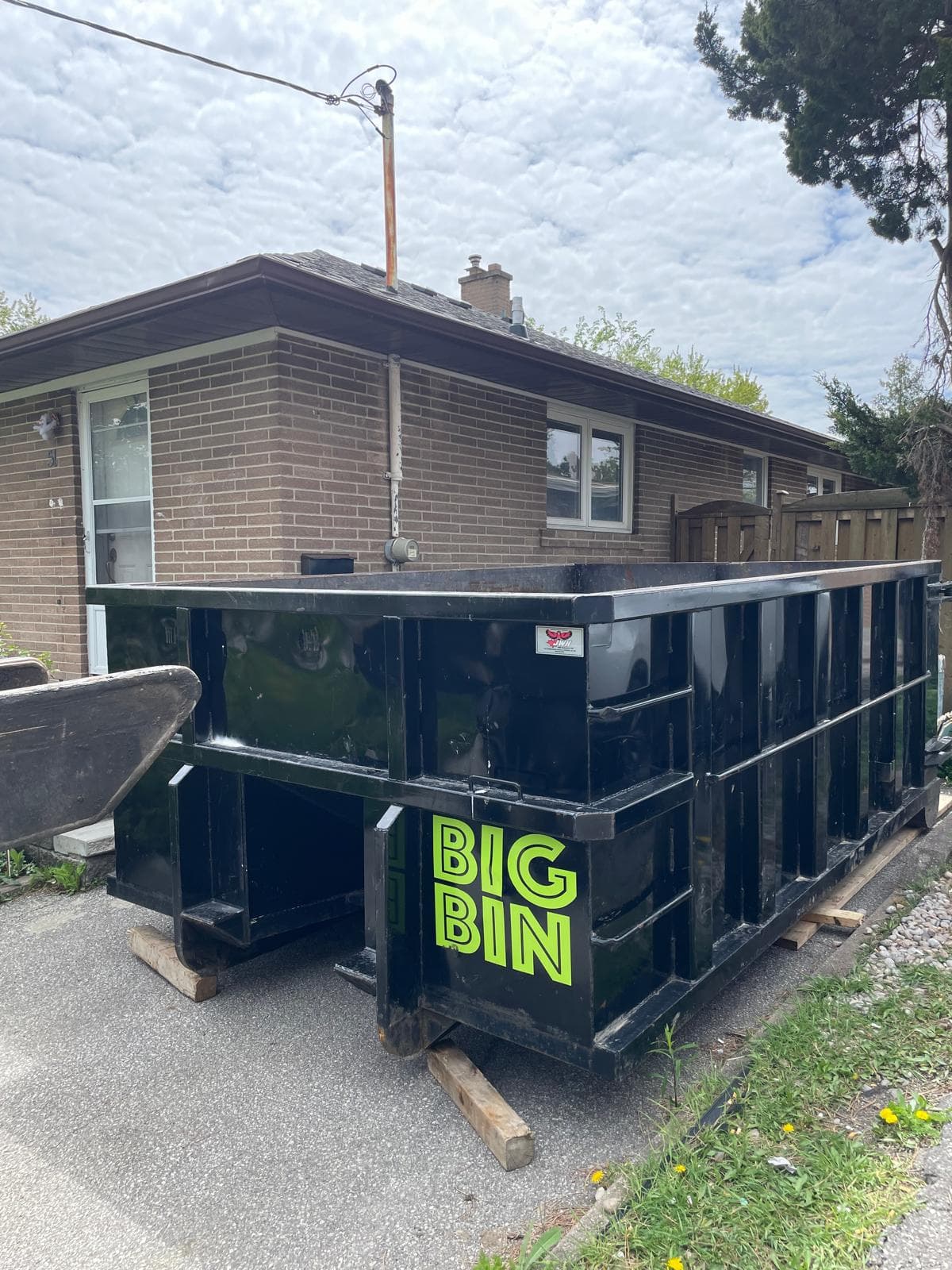
Open-top roll-off bins in 14, 30 and 40 yard, delivered from Mississauga, Ontario. The truck carries the whole container away and leaves an empty one, so a bin can stand for an afternoon or a whole project. Not scheduled weekly collection.
- 5-Star Rated
- No distance charge
- 7 days included
- Order by 3PM, next-day delivery
Quick answer
Which company provides commercial bin and dumpster service near Mississauga?
Big Bin — our company — rents commercial roll-off bins from a base in Mississauga, Ontario, and delivers east to Oshawa, north to Orangeville, west to Hamilton. The fleet is three sizes: 14, 30 and 40 yard. A roll-off bin can sit on a job site for one afternoon or for a whole project, because the truck takes the full container away and leaves an empty one rather than tipping it on the spot. What decides a mixed-waste bill is weight, since disposal sites charge by the tonne. The free weight estimator on this site puts a number on the weight, which is the part a business cannot see when it books.
Why rent from Big Bin
The number you are quoted is the number you pay
Every charge that can ever reach an invoice is listed and explained before you book, not discovered afterwards. Tax is shown inside the figure rather than added at the end.
The same price across the whole delivery area
A job at the far edge of where Big Bin delivers costs what one round the corner from the yard costs. Distance changes the drive, not the invoice.
Order by 3PM, and a bin can be there the next day
That is a cut-off rather than an average, so it is something you can plan a job around. Whether a bin can reach you the same day you ring depends on how full that day already is, and that is a question for the call.
7 days included, and no contract to sign
The rental is the job, not a schedule you are joining. Keep the container longer and the extra days are priced and named; nothing renews and nothing has to be cancelled.
A real price without phoning for it
Postal code, material, size and your dates, and the figure comes back with the tax already in it — priced for your own days rather than for a typical week.
Commercial bin rental: the facts
- Rentals from
- $650, before HST
- Service area
- east to Oshawa, north to Orangeville, west to Hamilton
- Based in
- Mississauga, ON
- Bin sizes
- 14 yard · 30 yard · 40 yard — the volume it holds, in cubic yards
- Bin type
- Roll-off. The whole container leaves on the truck and an empty one comes back
- How long a bin can stay
- One afternoon, or the length of a project
- Front-load route collection
- Not offered. That is a 2–8 yard bin with lifting sleeves that stays at a building and is tipped on a fixed day
- Customers
- Commercial, industrial and construction sites, and households
- Ordering hours
- Monday to Friday, 6:00 am – 6:00 pm. Saturday, 9:00 am – 5:00 pm. Sunday, closed
- Phone
- 416-458-4324
- Getting a price
- Postal code, material and dates in the quote — about 30 seconds
- Weight on a mixed load
- An allowance that rises with the bin, then a rate per tonne at the scale
- Vendor document pack
- Sent on request — call and ask for whichever of the four your procurement needs
- Swap terms and turnaround
- A full mixed-waste bin swaps for an empty one at the drop-off rate for that size, and the replacement brings its own tonnage. Next day if the order is in by 3PM the day before. Same day depends on how busy that day is — ask on the phone
What each size costs to rent
| Bin size | What it suits | Weight included | Price from |
|---|---|---|---|
| 14 yard | A bathroom or kitchen strip-out, a garage clear-out, one room back to the studs. | 2 tonnes | $650 |
| 30 yard | A full renovation, a roof tear-off, a house clear-out, a mid-size demolition. | 3 tonnes | In the quote |
| 40 yard | A whole-house renovation, a commercial fit-out, sustained site work. | 4 tonnes | In the quote |
The larger two are priced in the quote, with your own dates counted and the tax already inside the figure.
What our customers say
From our Google Business Profile, read on 2026-09-16
I would like to shout out these guys! Finding a waste disposal company that handles heavy materials like concrete without a bunch of hidden fees or headaches is usually very difficult but Big Bin made the process very easy. Pricing was great and the team was very professional. I would genuinely recommend them for any big project!
Ayman Khaled On time, quick and easy to communicate with, and great service all around
Eldin Malkic Amazing work ! Very good time that takes good care of you !
Evgeny Litvinenko
Does the bin stay on site, or does it get hauled away each time?
A commercial roll-off bin stays on site as long as the job needs it, and is carried away whole rather than emptied where it stands. Two services answer a search for commercial waste. The line between them is the equipment, not how often anything happens.
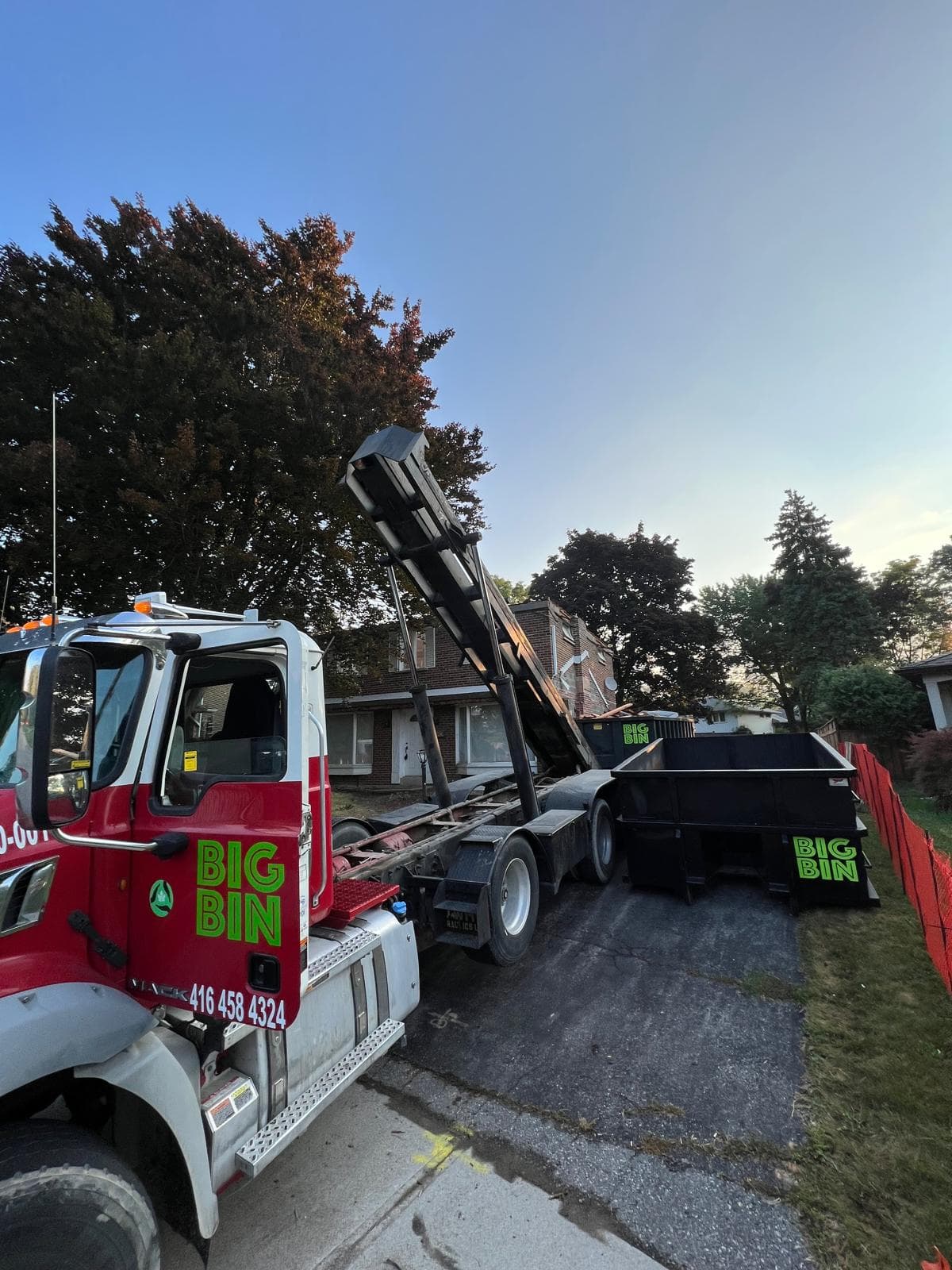
A roll-off is an open-top steel container. The truck backs up, hooks it, and winches the whole thing onto its own frame. Nothing is tipped on site. That is the service Roll-off bin rental covers, in three sizes: 14, 30 and 40 yard.
Because the container leaves with the load inside it, no collection schedule is attached. When it fills, the truck can bring an empty back so the crew keeps working. Whether that swap is included or billed as its own haul is worth settling on the phone before a long job starts.
Whether a given address is on a run at all is the other half of the question, and Bin rental near you covers the service boundary.
The other service is front-load route collection. That is a two-to-eight cubic yard container with sleeves for a truck’s forks. It stays at the building, and a truck arrives on a fixed day to lift it over its own cab and tip it in. Big Bin has three roll-off sizes and no front-load bins, so it does not run route collection.
So a business wanting a container emptied every Tuesday and left in place needs a scheduled collection company. A site producing debris — a fit-out, a demolition, an excavation — wants the opposite: a roll-off swapped as it fills. Construction bin rental follows that through the stages of a build, and Roll-off bins explained covers how the truck places one.
Swapping is what that second shape actually costs on a live site, and it is priced as a movement rather than as a new rental: taking the full container away and leaving an empty one is charged at the rate for setting a bin down, and the empty one arrives with its own weight allowance attached. Heavy material works differently — a clean concrete or clean fill haul has no swap rate at all, because the price is already a single complete trip out and back.
Work out what your load weighs first
A mixed-waste bin carries a tonnage, and weight above it is the part of a commercial bill that moves. The estimator turns the dimensions of what you are clearing into tonnes, using the published figures further down this page.
Which bin size does a commercial job need?
The right bin size for a commercial job is set by what the debris weighs at least as often as by how much room it takes up. Big Bin owns three: 14, 30 and 40 yard.
For light, bulky material the volume runs out first. Fit-out debris, packaging, fixtures and framing offcuts fill a 40 yard bin long before approaching a weight limit. So the largest bin the site can take is usually the cheapest way to move it.
For broken concrete, brick and excavated soil it inverts. A 14 yard bin of broken concrete already weighs about 5 to 12 tonnes on the published figures below. Ontario caps what a loaded commercial vehicle may weigh by axle configuration — how many axles the truck has and how far apart they sit — under O. Reg. 413/05, Vehicle Weights and Dimensions. That ceiling is why clean concrete and clean fill are sold in the 14 yard and in no other size.
There are also sizes Big Bin does not have — no 4, 6, 8, 10 or 20 yard bin. The Bin size guide takes each one in turn and names the nearest that exists. How a price is built by size is on What a bin costs.
What does a commercial load actually weigh?
A commercial load’s weight, not its volume, is what a disposal facility charges on. Every site that accepts construction and demolition debris bills by the tonne, so the same steel container can cost several times as much to empty depending on what went into it.
A 30 yard bin of mixed renovation debris — timber, drywall, cabinets — runs roughly 4 to 11 tonnes, on figures measured across 556 weighed truckloads by the Minnesota Pollution Control Agency. The same volume of broken concrete would be two to three times that, and past what a truck may legally carry. Nothing about the container changed; the material did. That is the number the next section is about.
Both ends are published because the sources genuinely disagree. The United States Environmental Protection Agency puts a cubic yard of concrete at 860 pounds; a Californian city chart puts it at 1,855. A cubic yard of rubble tipped loose is not a cubic yard of slab packed tight, and choosing one figure would look more precise and be less accurate.
Those agencies are American, and it is worth saying why: we could not find a Canadian federal or provincial body that publishes what a cubic yard of construction debris weighs. A cubic yard of concrete does not weigh less in Ontario than in Minnesota, so the figures transfer. What does not transfer is the law, and every rule here about trucks, hauling and insurance is cited to Ontario.
What does your debris weigh? applies the table below to your own load, in your browser.
| Material | Pounds per cubic yard, as published | Tonnes per cubic yard | Published by | What is being measured |
|---|---|---|---|---|
| Mixed renovation debris | 323 – 838.2 | 0.15 – 0.38 | Minnesota Pollution Control Agency | The ordinary contents of a renovation bin: wood, drywall, cabinets, flooring, packaging. Measured across 556 weighed truckloads, and two other agencies land inside this range — 417 lbs per cubic yard from the EPA and 484 from a Florida study of 171 weighed loads. |
| Demolition debris | 332 – 676.8 | 0.15 – 0.31 | Minnesota Pollution Control Agency | Whole-structure demolition rather than a renovation strip-out. Measured across 289 weighed truckloads. |
| Broken concrete | 860 – 1,855 | 0.39 – 0.84 | United States Environmental Protection Agency, Office of Resource Conservation and Recovery · City of Woodland, California | Slab, footing and foundation concrete, with or without reinforcing bar. The low figure is concrete as it turns up in a mixed waste stream; the high figure is a bin loaded with concrete and nothing else, which is what a driveway tear-out actually produces. |
| Concrete mixed with soil | 987.3 – 1,814 | 0.45 – 0.82 | Minnesota Pollution Control Agency | Measured, not estimated: the middle half of 75 real truckloads of concrete-and-dirt weighed at a disposal facility. The closest published figure to what a heavy bin on a driveway job actually weighs. |
| Soil, dirt and clean fill | 929 – 2,052 | 0.42 – 0.93 | United States Environmental Protection Agency, Office of Resource Conservation and Recovery · City of Woodland, California | Excavated earth. Moisture moves this figure more than any other on the page — the same soil after three days of rain can be a third heavier, and nothing on a website can tell you which you have. |
| Brick | 3,024 | 1.37 | City of Woodland, California | Whole brick. The heaviest thing per cubic yard on this page, and the figure most likely to catch somebody out: half a cubic yard of brick weighs more than a whole cubic yard of most other debris. Only one public figure could be sourced for it, and that document carries no publication date — treat it as the weakest row here. |
| Broken asphalt | 773 – 1,380 | 0.35 – 0.63 | United States Environmental Protection Agency, Office of Resource Conservation and Recovery · City of Woodland, California | Driveway and road surface, broken out. Lighter than concrete for the same volume because it is stone chippings held together, not one solid mass. |
Why a full bin is not always a legal load
A full bin and a legal load are two different things: the limit belongs to the truck on the road, not to the container.
The weights themselves are in O. Reg. 413/05. The plainer document is the Ministry of Transportation’s guide to oversize and overweight vehicles and loads, which explains that a vehicle over those limits needs a permit under the Highway Traffic Act before it moves. The limits are set by axle configuration, not by what a body can hold.
Put that beside the table above. Forty cubic yards of broken concrete is roughly 16 to 34 tonnes of material, before the truck’s own weight is counted at all. No ordinary axle configuration carries that, which is why the large containers are sold for light material and the heavy stuff goes in the 14 yard. How that lands against Ontario’s limits still varies with the vehicle, so ask what will be carried in the size you are ordering.
A second limit has nothing to do with weight: every container carries a line painted a foot and a half down from its rails, and a heaped load above that one is refused on securing grounds however light it happens to be.
That ceiling is what a weight allowance is for on a mixed-waste bin. A price including a tonnage is dividing a legal payload among the customers who share it, not being ungenerous, and a load over it is either lightened before the truck leaves or billed per tonne. Clean concrete and clean fill have no allowance at all — a fill line stands where the tonnage would be.
Which way it lands belongs in writing before the bin is ordered. The complete list of chargeable items sits on Rental agreement and fees, and What does your debris weigh? tells you in advance which side of the line a load sits on.
Know the weight before you order the bin
Work out roughly what the load weighs, then start a quote with a size that can legally carry it. Neither step asks for an email address.
What a commercial customer should check before booking a hauler
Five documents are worth asking any hauler for before a bin goes on a commercial site, and each is checkable by the business asking.
Moving waste off a site needs a provincial permission, and for non-hazardous solid waste it is a registration rather than an approval. The Ministry of the Environment, Conservation and Parks defines a waste transportation system as one transporting waste beyond a site’s boundaries. Such a system registers on the Environmental Activity and Sector Registry under O. Reg. 119/25. What it permits is worth reading: collection, handling, transferring, transporting and temporary in-vehicle storage. Mixing or bulking needs a separate approval.
The provincial guidance for that registration carries two requirements a customer can ask about directly. Every waste transportation vehicle must be insured to a stated minimum, covering spill liability. And every driver must complete the required training at least once in every 36-month period. The figure is in the table below.
A commercial vehicle operator’s registration is the other half. Ontario requires one for trucks over 4,500 kg registered gross or actual weight — every roll-off truck. The CVOR abstract is the province’s summary of that carrier’s collisions, convictions and inspections. Ask for the abstract, not the certificate: one says a carrier is registered, the other says how it drives.
Workplace insurance is where timing catches businesses out. A clearance shows a business is registered with the Workplace Safety and Insurance Board and current on premiums and reporting. It is valid for up to 90 days, so on a longer job one handed over on the first morning expires part-way through.
The fifth is not a credential: on a load billed by weight, ask for the weigh ticket with the invoice, since it is the only proof that the tonnage charged is the tonnage that crossed the scale. There is more for repeat buyers on Bin rental for contractors.
| Document | What it proves | Who issues it | How current it stays |
|---|---|---|---|
| Waste transportation registration | That the hauler may legally move waste off your site, under O. Reg. 119/25 | Ontario Ministry of the Environment, Conservation and Parks, through the Environmental Activity and Sector Registry | Held on the registry. Ask when it was last confirmed |
| Commercial vehicle operator’s registration abstract | The carrier’s own safety record — collisions, convictions and inspections | Ontario Ministry of Transportation | Issued on request, so ask for a recent one rather than a filed copy |
| Workplace insurance clearance | That the business is registered and up to date on premiums and reporting | Workplace Safety and Insurance Board | Valid for up to 90 days, so it expires during a long job |
| Certificate of insurance | Liability coverage for the work, naming your company for the project. The province also requires a minimum of $2,000,000 (Ontario Ministry of the Environment, Conservation and Parks, updated 3 October 2025) on the waste transportation vehicle itself, including spill liability | The hauler’s insurance broker | Issued per project, which is the one document that genuinely cannot be pre-published |
Need the vendor paperwork before a bin goes on site? Ask for it directly. Call 416-458-4324
Where does a commercial load go after pickup?
A commercial load goes to a receiving facility, where it is weighed, tipped and sorted onward, and what happens there depends on whether the bin held one material or several.
A registered hauler may carry and store waste in the vehicle but not mix or blend it, per the provincial description of those permissions. So the load leaving your site is the load that arrives.
Which is why a clean load has to start clean. A bin of broken concrete with no drywall, timber, packaging or household rubbish is inert material — it will not rot or break down — so it can be crushed and reused, and it costs less to dispose of than the same volume of mixed debris. One sheet of drywall reclassifies the whole bin at the gate, and the charge lands on the bin rather than the sheet.
Two of those streams are covered in full: Concrete disposal, and Soil and fill disposal, where a provincial rule governs where earth may go.
The gate is a regional matter, and one worth knowing before a container is ordered: a Region here charges more than double for fill material as for general waste, so which stream a load counts as moves the bill before volume is argued about.
What does a commercial bin cost, and how does it work?
A commercial bin is priced as a cycle rather than a rental period — the three steps below, repeating on a long job.
So a six-month project is not one long rental. It is a series of hauls, billed as hauls.
Which of two price shapes applies depends on what the site is throwing out. Mixed waste carries a base for the container and two truck trips plus a tonnage, with weight beyond it charged per tonne — so an advertised number is only real while a load stays under the allowance. Clean concrete and clean fill carry no tonnage: one figure per haul, capped by a fill line.
What a bin costs sets out how a price is built, Rental agreement and fees for the full schedule of chargeable items, and Get a quote starts one.
01
Tell us about the job
Call or email with what you are clearing, where a container can stand, and when you need it.
02
The bin arrives
A truck sets the container where you asked. Nothing is tipped on site: you or your crew fill it, on your own schedule.
03
It leaves full
The truck takes the whole container away, and the load crosses a scale at the receiving site.
Questions a commercial customer asks
Can a bin stay on a commercial job site for the whole project?
Yes. A roll-off bin is not tied to a collection schedule. It sits where the truck put it until you ask for it to be taken away — the same afternoon, or six months later. On a long job the bin gets swapped as it fills: the truck takes the full one and brings an empty one back, so the crew keeps working. On mixed waste that exchange is charged at the drop-off rate for the size, and the replacement arrives with its own weight allowance. Clean concrete and clean fill work differently, because their price already buys one complete trip out and back — a second load there is a second full haul rather than a swap. Order by 3PM and a container can be with you the next day.
Is a commercial bin rental the same as commercial garbage pickup?
No, and the difference is the equipment rather than how often it happens. A bin rental means a large open-top container is dropped off, filled, and carried away whole on the back of a truck. Commercial garbage pickup usually means a smaller container with lifting sleeves. That one stays at the building permanently, and a truck tips it into itself on a fixed day each week. Big Bin runs the first kind. It does not run route collection, so a business that wants a container emptied every Tuesday needs a scheduled waste collection company instead.
What size bin does a commercial job need?
It depends on the weight as much as the volume. Big Bin owns 14, 30 and 40 yard bins. For light bulky material — packaging, fixtures, office clear-outs, framing offcuts — the biggest bin that fits the site is usually right, because volume runs out before weight does. For broken concrete, brick and excavated soil it inverts: a 14 yard bin of broken concrete already weighs about 5 to 12 tonnes on the published figures. That is why clean concrete and clean fill go in the 14 yard and are not offered above it. Put your dimensions into the weight estimator before choosing.
Why do bin companies put a weight limit on a bin that is not full?
Because the limit belongs to the loaded truck on the road, not to the container. Ontario caps what a commercial vehicle may weigh by axle configuration. A bin big enough to hold 40 cubic yards of dense material can hold more than the truck carrying it is allowed to weigh. So the weight included in a mixed-waste price is a share of a legal payload rather than a company being ungenerous, and a load over it either gets reduced before the truck leaves or costs more. Clean concrete and clean fill carry no weight in the price at all; the same ceiling is handled there by selling them in one size only.
What documents should a business ask a bin rental company for?
Five, and all five are checkable. A waste transportation registration, because moving waste off a site in Ontario needs one. A commercial vehicle operator’s registration abstract, which is the province’s summary of a carrier’s collisions, convictions and inspections. A current workplace-insurance clearance, which expires — it is valid for up to 90 days, so one handed over on day one of a long job runs out during it. A certificate of insurance naming your company for the project. And a weigh ticket with the invoice, so the tonnage you are billed for is the tonnage that crossed the scale.
Who pays if a commercial load turns out to be over the truck’s legal weight?
The overweight part of the load has to come off before the truck goes anywhere. So in practice the cost lands on whoever filled the bin — either as a second haul, or, on a mixed load, as a per-tonne charge above the weight included in the price. The exposure is not only financial, either. An overweight commercial vehicle on an Ontario road is the carrier’s problem at the roadside, which is why a hauler that explains its weight limit up front is describing a legal ceiling rather than inventing a fee.
Does Big Bin take mixed commercial waste, or only clean loads?
Both, and they are priced and handled differently. A bin holding one material and nothing else is cheaper to dispose of than a mixed one, which is why the clean loads are sold as a complete haul with no weight charge and the mixed ones carry a tonnage. The rule that goes with that is firm rather than a preference: a single sheet of drywall or a bag of household rubbish in a bin of clean concrete contaminates the load, and a contaminated bin is not collected. Where one has already been filled that way, a charge applies on top. It is named on the rental agreement page alongside every other charge that can reach an invoice, and the amount comes with the quote for the job rather than off a public page.
Sources
Every fact on this page that is not simply how renting a bin works, and the public document it came from.
Source 1
Waste Management Facilities: hours, locations, site fees and accepted materials
Regional Municipality of Durham — no publication date printed; retrieved 2026-09-14
Source 2
Commercial vehicle operator’s registration (CVOR)
Ontario Ministry of Transportation — updated 9 February 2026
Source 3
Waste transportation system: guidance for the Environmental Activity and Sector Registry
Ontario Ministry of the Environment, Conservation and Parks — updated 3 October 2025
Source 4
Environmental permissions: waste transportation systems
Ontario Ministry of the Environment, Conservation and Parks — updated 7 October 2025
Source 5
Workplace Safety and Insurance Board — updated 5 May 2026
Source 6
Government of Ontario — no publication date printed; retrieved 2026-08-11
Source 7
Guide to oversize/overweight vehicles and loads
Ontario Ministry of Transportation — 2 July 2025
Source 8
Volume-to-Weight Conversions (document w-sw2-08)
Minnesota Pollution Control Agency — September 2021
Source 9
Volume-to-Weight Conversion Factors
United States Environmental Protection Agency, Office of Resource Conservation and Recovery — April 2016
Reviewed August 2026Kenan Sljoka
Also on this site
Service
Construction bin rentalService
Concrete disposalService
Soil and fill disposalService
Bin rental near youService
Dumpster rental
Useful things to read
Free tool
What does your debris weigh?Page
Bin rental for contractorsService area
Bin Rental in MississaugaService area
Bin Rental in BramptonService area
Bin Rental in OakvilleService area
Bin Rental in WhitbyService area
Bin Rental in OshawaService area
Bin Rental in Pickering
Tell us what the job is producing
Say what the site is clearing out and how long a bin needs to stand there, and we will tell you which size holds it. Get a quote runs without an email address, and every way to reach the business is on Contact Big Bin.