Soil and fill disposal
Soil and fill disposalFrom $650, before HST
Roll-off bins for excavated soil and clean fill, in the 14 yard and no bigger. Soil is dense, so weight decides the size long before volume does. Ontario also has a rule written for excavated soil specifically, and this page sets out what it asks.
- 5-Star Rated
- No distance charge
- 7 days included
- Order by 3PM, next-day delivery
Quick answer
Where can you dispose of excavated soil and clean fill in Ontario?
Excavated soil in Ontario goes to a reuse site, a licensed facility, or a project that needs fill — and which one takes it depends on what the soil is, not on who moves it. Since 2019 the province has had its own rule for this, O. Reg. 406/19, and it asks the project to characterise its soil and name a destination before the first load leaves. Big Bin — our company — carries soil and clean fill in the 14 yard bin once a destination is settled, at a flat price per haul with no weight charge. Soil is one of the heaviest materials a bin carries, and the free weight estimator turns a dig into tonnes.
Why rent from Big Bin
The number you are quoted is the number you pay
Every charge that can ever reach an invoice is listed and explained before you book, not discovered afterwards. Tax is shown inside the figure rather than added at the end.
The same price across the whole delivery area
A job at the far edge of where Big Bin delivers costs what one round the corner from the yard costs. Distance changes the drive, not the invoice.
Order by 3PM, and a bin can be there the next day
That is a cut-off rather than an average, so it is something you can plan a job around. Whether a bin can reach you the same day you ring depends on how full that day already is, and that is a question for the call.
7 days included, and no contract to sign
The rental is the job, not a schedule you are joining. Keep the container longer and the extra days are priced and named; nothing renews and nothing has to be cancelled.
A real price without phoning for it
Postal code, material, size and your dates, and the figure comes back with the tax already in it — priced for your own days rather than for a typical week.
Soil and fill disposal: the facts
- Rentals from
- $650, before HST
- Service area
- east to Oshawa, north to Orangeville, west to Hamilton
- Bin size
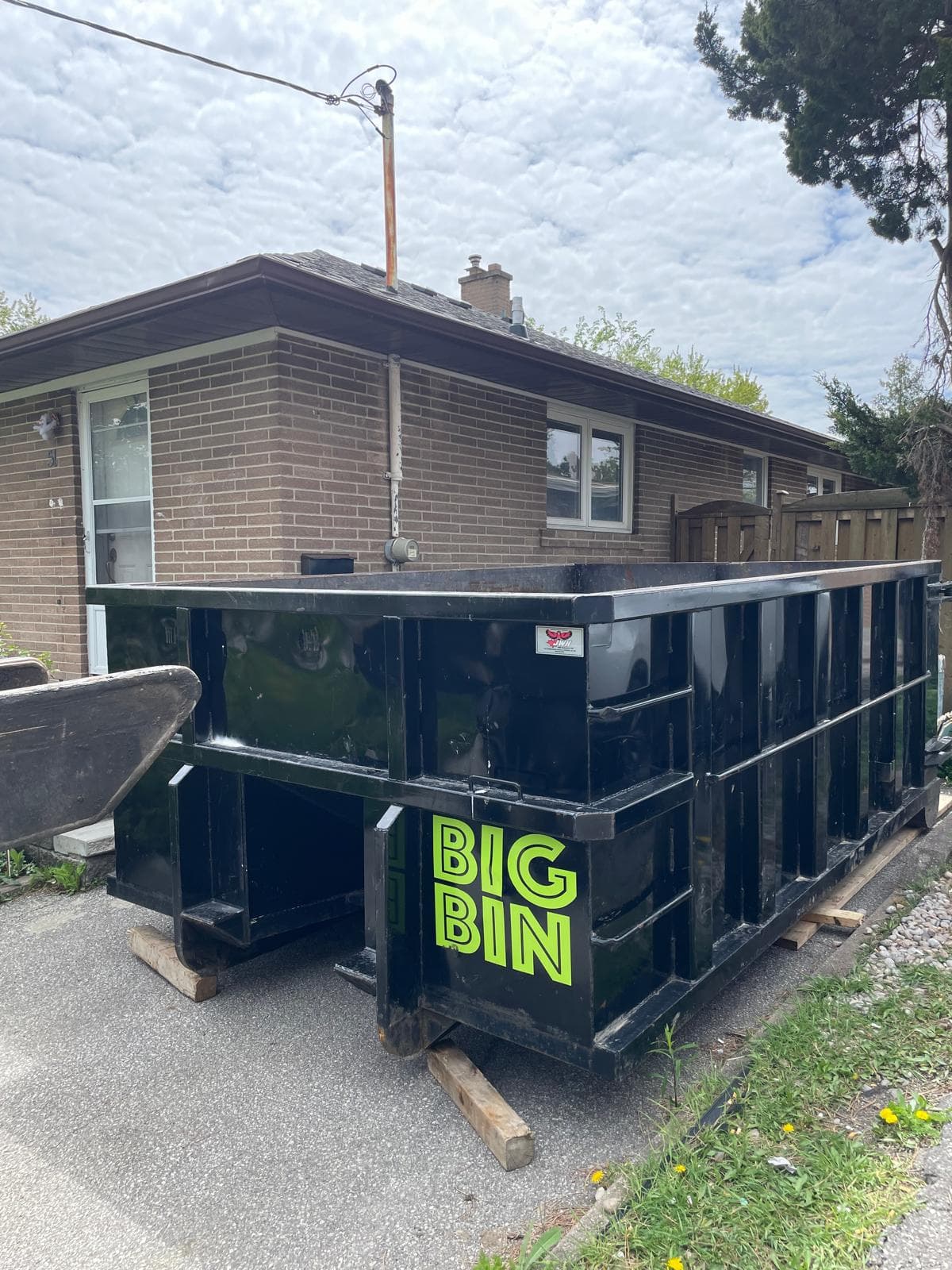
- 14 yard — cubic yards of volume; soil hits the weight limit first. Soil and fill are not available in a 30 or 40 yard bin. The 14 yard is the only size they go in.
- Bin type
- Roll-off, open-top. Carried away whole rather than tipped where it stands
- What "clean fill" means
- Excavated soil with nothing foreign mixed through it. A description of content, not a grade anybody issues
- What makes soil "excess soil"
- Soil dug up on a project and moved off it. Ontario’s O. Reg. 406/19 sets the rules for managing it
- Customers
- Excavation crews, pool and foundation contractors, landscapers, and households
- Ordering hours
- Monday to Friday, 6:00 am – 6:00 pm. Saturday, 9:00 am – 5:00 pm. Sunday, closed
- Phone
- 416-458-4324
- Getting a price
- Postal code, material and dates in the quote — about 30 seconds
- What limits the load
- A painted fill line inside the bin. Soil and fill carry no weight charge, so nothing is settled against a scale ticket afterwards
- Where soil and fill are tipped
- At the licensed facilities serving this region — each Region runs its own and publishes its own gate rate for fill. Which one a particular load reaches depends on where it was dug
- Whether contaminated soil is accepted
- No. Big Bin carries non-hazardous material only, so a soil bin is clean soil and fill — from a garden bed or a building site, at the same price either way
What our customers say
From our Google Business Profile, read on 2026-09-16
I would like to shout out these guys! Finding a waste disposal company that handles heavy materials like concrete without a bunch of hidden fees or headaches is usually very difficult but Big Bin made the process very easy. Pricing was great and the team was very professional. I would genuinely recommend them for any big project!
Ayman Khaled On time, quick and easy to communicate with, and great service all around
Eldin Malkic Amazing work ! Very good time that takes good care of you !
Evgeny Litvinenko
What do Ontario’s excess-soil rules ask of a project?
Ontario has had a rule written for excavated soil specifically since 2019. It is O. Reg. 406/19, On-Site and Excess Soil Management, and the ministry publishes its own guide to it. What is below is what the rule asks. It is not a compliance opinion, and no website can give you one.
The first thing it settles is whether the soil is waste at all. Excess soil is not automatically waste. Whether it counts as waste turns on the standards the soil meets and on how it is going to be reused. That is the part most people have backwards. It matters commercially, because soil that qualifies for reuse has destinations open to it that waste does not.
The rule then scales what it asks to the size of the project and the risk of the site. Above 2,000 cubic metres, the province asks for fuller reuse planning — sampling and characterisation, and a destination worked out before soil moves. A reuse site receiving more than 10,000 cubic metres has to register. It also has to run procedures for tracking and inspecting the soil it takes in. Testing, tracking and registration have applied since 1 January 2023, and some exemptions apply.
Read plainly, that is a sequence rather than a pile of paperwork. Find out what the soil is. Work out where it can go. Then move it, with a record of where each load went.
The practical consequence for scheduling is the part worth planning around. Characterisation happens before the soil moves, not while a bin sits on the drive. On a project large enough to trigger it, the assessment belongs in the programme next to the excavation itself.
The ministry page linked above is the document to read, and it links the regulation itself. At the stage of ordering bins rather than planning them, Construction bin rental covers how a build produces different loads at each stage, and Bin rental for contractors covers repeat work; to ask what a haul would involve, Contact Big Bin.
What is clean fill, and what stops soil being clean?
"Clean fill" is not a grade anybody issues and no certificate arrives with it. The phrase means excavated earth with nothing foreign mixed through it, which is why two loads that look identical on a driveway can be treated differently at the gate, where the receiving site grades them on arrival.
What breaks it is ordinary site material rather than anything exotic: broken concrete, brick, asphalt, wood, plastic sheeting and root mat all change what a receiving site will take, and so can topsoil and organic matter, because a fill site wants inert material rather than something that will settle or rot.
A refused load is the expensive version of this: the material still has to go somewhere, so the haul is paid twice — once to arrive and be turned away, again to reach a site that will take it. Settle what is going in before the bin is filled.
The other half is physical: once rubble is mixed through a pile of soil it does not come back out at any sensible cost, so separating while digging is cheap and separating afterwards is a sorting job nobody wants.
Where fill ends up is a region rather than an address. Durham lists fill material as soil, dirt, brick, gravel, rubble, sand, cement and concrete, and prices it at $375 per 1,000 kilograms (Regional Municipality of Durham, no publication date printed; retrieved 2026-09-14) — more than double its general rate, which inverts what most people assume about a clean load. Halton runs one site for the whole Region and takes clean soil from residential vehicles only; Peel runs six Community Recycling Centres instead. That is what each Region publishes about its own gates, and it holds whoever hauls it.
What does a bin of soil weigh?
A bin of soil weighs more than almost anything else you could put in it: published figures put a cubic yard of excavated earth between 929 and 2,052 pounds, so a What does your debris weigh? run on real dimensions is worth doing before a size is chosen.
Moisture explains most of that spread and it is the variable nobody can look up: the same soil after three days of rain can be a third heavier than it was when the trench was opened, and clay holds water that sand drains away. So the size that fits by volume is usually not the size that is legal by weight, which is the whole reason a soil job is quoted differently from a renovation clear-out.
The ceiling itself belongs to the loaded truck on the road rather than to the container, and it is set by axle configuration under Ontario law: how the truck’s axles are arranged, not how large its container is. Why that is, and who carries the cost when a load exceeds it, is set out on Commercial bin and dumpster rental.
A line is painted inside every container too, a foot and a half below the rim: 31" off the floor of the 14 yard, 46" in the 30, 66" in the 40. That is containment rather than law — a load above the rails cannot be sheeted, so it cannot travel — and on soil the ceiling above binds long before it does.
The table below shows how fast each material reaches a tonnage a renovation load never approaches.
| Material | Pounds per cubic yard, as published | Full 14 yard bin | Published by |
|---|---|---|---|
| Soil, dirt and clean fill | 929 – 2,052 | 5.9 – 13 t | US EPA · City of Woodland, California |
| Concrete mixed with soil | 987.3 – 1,814 | 6.3 – 11.5 t | Minnesota Pollution Control Agency |
| Broken concrete | 860 – 1,855 | 5.5 – 11.8 t | US EPA · City of Woodland, California |
| Brick | 3,024 | 19.2 t | City of Woodland, California |
Work out the tonnage before you pick a size
Measure the room the spoil will take up loose in the bin rather than the hole it came out of, because soil bulks up once it is dug. The estimator returns tonnes, which is the number that decides the size — and no email address is wanted at any point.
What about contaminated soil, and who assesses it?
Soil from some sites is treated as higher-risk before anybody tests it, because of what the land was used for. The ministry names gas stations and industrial sites as examples, and those sites get enhanced assessment, sampling and characterisation. Former dry cleaners, fuel storage and older manufacturing land sit in the same conversation.
That is a different job from a clean excavation. The destinations are different, the paperwork is different, and the cost is different. A load of soil from a former filling station is not a load a fill site will take on the strength of it looking like earth.
Assessing it is work for a qualified person, which is a role the regulation defines rather than a job title anybody can adopt. The ministry’s own guidance is where that role and the standards attached to it are set out.
Big Bin is a haulier. It supplies the bin and moves the load. It does not assess soil, does not act as a qualified person, and does not advise on whether a project complies with anything.
So if the land has a history, the order of operations runs the other way round from a normal job. The assessment comes first and it decides where the soil may go. The bin is booked once there is somewhere for it to be taken.
Where to go instead, by category: an environmental consultancy or a qualified person for the assessment, the ministry page above for what the rule asks, and the receiving site itself for what it will accept. Whether Big Bin will carry the material once it has been characterised is a question worth asking directly. Contact Big Bin to ask it directly.
Once you know what the soil is and where it is going, we can quote the haul. Call 416-458-4324
What does soil disposal cost, and how does a job run?
A soil bin is sold by the haul, not by the tonne. One figure covers the delivery and the collection, and no part of it is settled against a weighbridge afterwards.
That is worth knowing on a material this dense, because the usual advice runs the other way. Where a bill turns on weight, wet clay can pass an allowance while the container still looks half empty. Here there is no allowance to pass — what the load may not do is stand above the painted line inside the bin.
The second thing that is different is that an excavation is rarely one bin. A basement lowering or a pool dig produces a series of loads, and each load is its own haul. A price per haul tells you more about the job than a daily rate does.
A swap on a multi-load dig is another complete cycle, so the arithmetic is the number of hauls rather than the days. What a bin costs sets out how the parts fit together, Roll-off bin rental covers what a rental includes, and Roll-off bins explained covers how the truck places and collects one. Get a quote starts a rental.
Two practical answers go with that on a dig. An order placed by mid-afternoon — three o’clock is the cut-off — can have a container on site the following day; whether one can reach you the same day you ring turns on how full that day already is, so it is a question for the call rather than a promise made here. And on a dig needing several loads, the clean fill bin has no swap arrangement at all — its price already buys one complete trip out and back, so a second load is simply a second trip at the same figure. Only the mixed-waste container works the other way, where an exchange is billed as a single movement rather than as a fresh rental.
01
Tell us about the job
Call or email with what you are clearing, where a container can stand, and when you need it.
02
The bin arrives
A truck sets the container where you asked. Nothing is tipped on site: you or your crew fill it, on your own schedule.
03
It leaves full
The truck takes the whole container away, and the load crosses a scale at the receiving site.
Soil on its own, or soil and concrete mixed?
Soil dug out beside a slab usually arrives at the bin with lumps of the slab in it. That mixture is its own material, and it is worth deciding about deliberately rather than by accident.
It is also the one combination with a directly measured figure behind it. The Minnesota Pollution Control Agency weighed 75 real truckloads of concrete and dirt arriving at a disposal facility, and published the quartiles rather than an average. The middle half of those loads ran between 987 and 1,814 pounds per cubic yard. That is the closest published number to what a driveway tear-out actually puts on a scale.
Compare it with the rows above and the useful point appears. Mixed concrete and soil is heavier at its light end than either clean soil or clean concrete is at theirs. The mixture is not a compromise between the two — it is denser than both, because the smaller material fills the gaps the larger one leaves.
Commercially the mixture is the awkward option, because a receiving site that has a good rate for clean earth and a good rate for clean rubble often has neither for the two together. Whether that is worth a second container depends on how much of each the dig is producing.
If the slab is the bigger half of what is coming out, the argument runs the other way round and Concrete disposal is the page for it. Whether the two may share one bin is settled, and the answer is no.
They do not travel together here, which turns the question above into an arithmetic one rather than an open one: two containers, or one container filled twice. A container holding both is left where it stands rather than collected, and there is a separate charge where the loading has already happened — so this is a decision worth making with a shovel in your hand on the first morning, not one to meet on collection day.
What will a bin of soil weigh?
The published figures for soil differ by more than two times between their low and high ends, and moisture is most of the reason. Put the dimensions of the excavation in and the estimator returns a range rather than a single number, because a range is what the sources actually support.
Questions about soil and fill
Is excavated soil legally waste in Ontario?
Not automatically, and that is the point of the regulation. Under O. Reg. 406/19 whether excess soil counts as waste depends on the standards the soil meets and on how it is going to be reused. Soil that qualifies for reuse has destinations open to it that waste does not. The ministry publishes its own guide to this and it is linked on this page. Big Bin hauls soil and does not assess it, so nothing here is a compliance opinion about a particular pile.
Do I need a soil report before I dig?
That depends on the size of the project and the history of the site, and it is a question for the ministry guidance or a qualified person rather than for a bin company. What the regulation does is scale what it asks to those two things: above 2,000 cubic metres it asks for fuller reuse planning, including sampling and characterisation and a destination worked out before soil moves. Testing, tracking and registration requirements have applied since 1 January 2023, with some exemptions.
What counts as clean fill?
Excavated earth with nothing foreign mixed through it. It is a description of what is in the load rather than a grade anybody issues, so no certificate arrives with it. Broken concrete, brick, asphalt, wood, plastic sheeting and root mat all change what a receiving site will take, and organic matter can too, because a fill site wants inert material. The decision is made where the load arrives rather than where it was dug.
Can I put soil and concrete in the same bin?
Physically it happens on most excavations next to a slab, and the mixture is its own material rather than a compromise between the two. It is denser than either on its own, because the smaller pieces fill the gaps the larger ones leave. The Minnesota Pollution Control Agency weighed 75 truckloads of concrete and dirt, and put the middle half between 987 and 1,814 pounds per cubic yard. Commercially it is the awkward option, since a site with a good rate for clean earth and a good rate for clean rubble often has neither for the two together. Which is why the answer here is no: the two do not share a container. A bin that arrives holding both is not taken away, and one already loaded that way carries its own charge — named on the rental agreement page with every other chargeable item, and quoted for the job. Two containers, or one container filled twice.
Why does a small bin of soil cost the same as a large bin of renovation debris?
Because what it costs to get rid of follows the weight rather than the volume, and the two loads weigh about the same. A receiving site weighs the truck in, weighs it out and bills the difference per tonne, so a 14 yard bin of excavated earth and a 40 yard bin of mixed renovation waste land in much the same place on the scale. You are not billed on that reading directly — soil and clean fill are sold as one flat haul with no weight charge at all — but it is why the flat figure sits where it does. The container is the cheap part; what went into it is not.
Does Big Bin take soil from a former gas station?
Call and ask. The ministry treats gas stations and industrial sites as higher-risk examples, so that soil gets enhanced assessment, sampling and characterisation before it goes anywhere, and assessing it is work for a qualified person as the regulation defines one. Big Bin supplies bins and moves loads; it does not assess soil or advise on compliance.
Where does clean fill actually end up?
One of three places, depending on what the soil is: a reuse site, another project that needs fill, or a licensed facility. Reuse is the outcome the regulation is built to enable, and a reuse site receiving more than 10,000 cubic metres has to register and run procedures for tracking and inspecting what it takes in. Call and we will tell you where a particular load is going before it leaves.
Sources
Every fact on this page that is not simply how renting a bin works, and the public document it came from.
Source 1
Ontario Ministry of the Environment, Conservation and Parks — updated 1 August 2025
Source 2
Waste Management Facilities: hours, locations, site fees and accepted materials
Regional Municipality of Durham — no publication date printed; retrieved 2026-09-14
Source 3
Halton Waste Management Site: hours, location, fees and accepted materials
Regional Municipality of Halton — no publication date printed; retrieved 2026-09-14
Source 4
Community Recycling Centres: locations and drop-off hours
Region of Peel — no publication date printed; retrieved 2026-09-14
Source 5
Volume-to-Weight Conversions (document w-sw2-08)
Minnesota Pollution Control Agency — September 2021
Source 6
Volume-to-Weight Conversion Factors
United States Environmental Protection Agency, Office of Resource Conservation and Recovery — April 2016
Source 7
City of Woodland, California — no publication date printed; retrieved 2026-08-11
Reviewed August 2026Kenan Sljoka
Also on this site
Service
Concrete disposalService
Construction bin rentalService
Commercial bin and dumpster rentalService
Bin rental near youService
Dumpster rental
Useful things to read
Free tool
What does your debris weigh?Page
Bin rental for contractorsService area
Bin Rental in MississaugaService area
Bin Rental in BramptonService area
Bin Rental in OakvilleService area
Bin Rental in WhitbyService area
Bin Rental in OshawaService area
Bin Rental in Pickering
Tell us what you are digging out
Say roughly how much soil is coming out, whether anything is mixed through it, and where a bin can stand. We will tell you which of the three sizes carries it. Get a quote needs no email address, and the phone number and hours are on Contact Big Bin.