Concrete disposal
Concrete disposalFrom $650, before HST
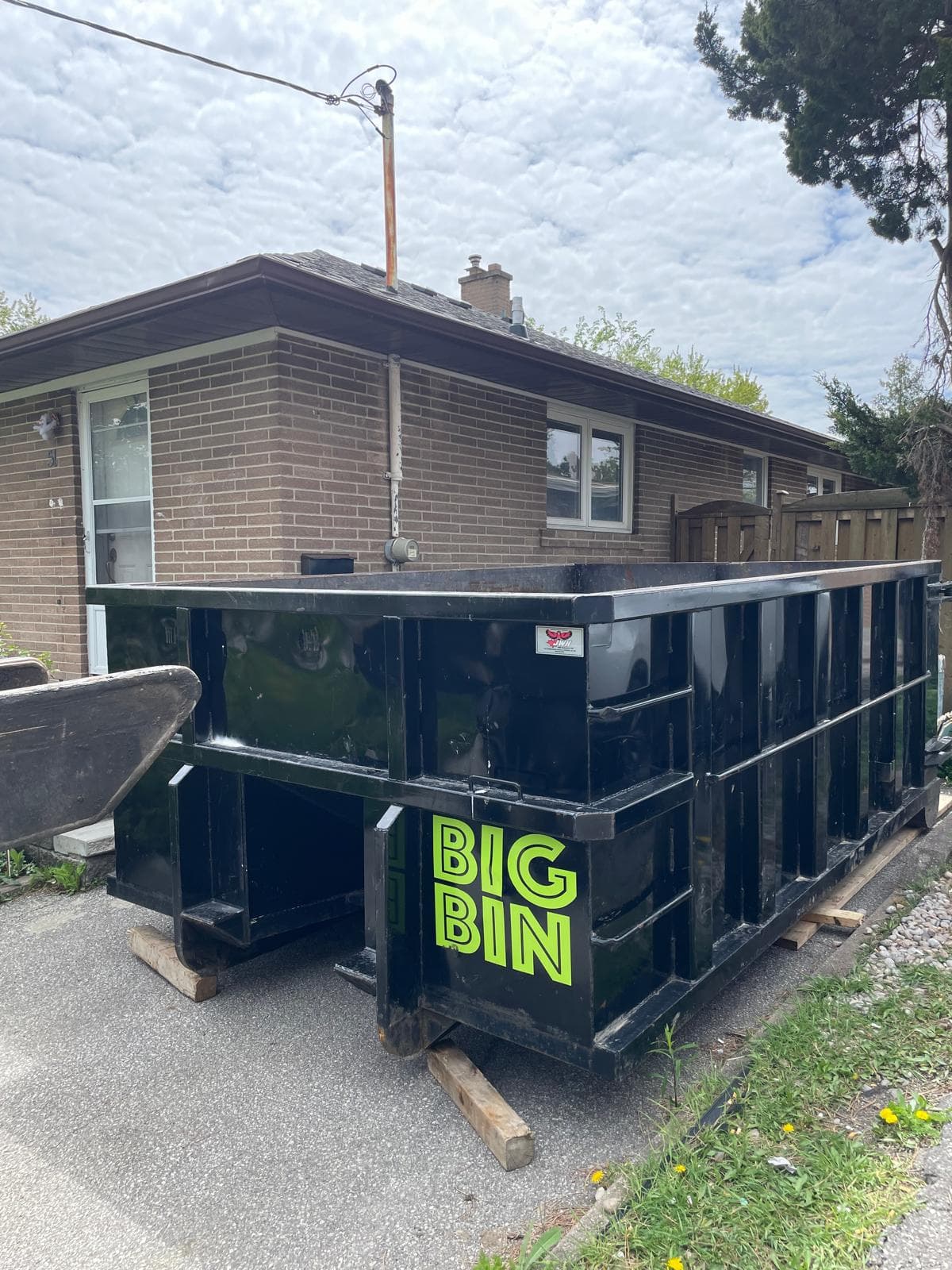
Roll-off bins for broken concrete, in the 14 yard and no larger. A slab takes up little room and weighs a great deal, which is why the bigger bins in the fleet are not on offer for it. Kept clean, the load is crushed and reused rather than buried.
- 5-Star Rated
- No distance charge
- 7 days included
- Order by 3PM, next-day delivery
Quick answer
Where does broken concrete go, and what does a bin of it weigh?
Broken concrete from a driveway, patio or slab goes to a facility that crushes it into aggregate for reuse, provided the load is clean — concrete and nothing else. Clean concrete costs less to tip than a mixed load, because the receiving site can sell what it makes. On the published figures a cubic yard runs from 860 to 1,855 pounds, which is why Big Bin — our company — carries it in the 14 yard bin and offers no larger size for it. It is never weighed for billing: the price buys one drop-off and one pickup, and a painted line sets the limit. The free weight estimator turns the space the rubble will fill into tonnes.
Why rent from Big Bin
The number you are quoted is the number you pay
Every charge that can ever reach an invoice is listed and explained before you book, not discovered afterwards. Tax is shown inside the figure rather than added at the end.
The same price across the whole delivery area
A job at the far edge of where Big Bin delivers costs what one round the corner from the yard costs. Distance changes the drive, not the invoice.
Order by 3PM, and a bin can be there the next day
That is a cut-off rather than an average, so it is something you can plan a job around. Whether a bin can reach you the same day you ring depends on how full that day already is, and that is a question for the call.
7 days included, and no contract to sign
The rental is the job, not a schedule you are joining. Keep the container longer and the extra days are priced and named; nothing renews and nothing has to be cancelled.
A real price without phoning for it
Postal code, material, size and your dates, and the figure comes back with the tax already in it — priced for your own days rather than for a typical week.
Concrete disposal: the facts
- Rentals from
- $650, before HST
- Service area
- east to Oshawa, north to Orangeville, west to Hamilton
- Bin size
- 14 yard — cubic yards of space, not tonnes. Clean concrete is not available in a 30 or 40 yard bin. The 14 yard is the only size it goes in.
- Bin type
- Roll-off, open-top. The container goes on the truck with the load inside it
- What makes a load "clean"
- Concrete and nothing else. Cast-in reinforcing bar is normally fine; wood, plastic, drywall and rubbish are not
- What a cubic yard weighs
- 860 to 1,855 pounds on the published figures, depending on whether it is loose rubble or packed slab
- Who orders it
- Homeowners taking out a driveway or patio, and demolition, landscaping and excavation crews
- Ordering hours
- Monday to Friday, 6:00 am – 6:00 pm. Saturday, 9:00 am – 5:00 pm. Sunday, closed
- Phone
- 416-458-4324
- Getting a price
- Postal code, material and dates in the quote — about 30 seconds
- What limits the load
- A painted fill line inside the bin rather than a weight at the scale. A clean concrete load carries no weight charge at all
- How high a heavy bin may be filled
- To the painted line, a foot and a half below the rim — 31 inches in the 14 yard. It is a loading rule rather than a weight limit, and on concrete the legal weight of the loaded truck binds well before it
- Where the concrete is tipped — unloaded at a receiving site
- At a site with a crusher, among the licensed facilities serving this region. How much of what Big Bin collects is reused rather than buried has not been counted
What our customers say
From our Google Business Profile, read on 2026-09-16
I would like to shout out these guys! Finding a waste disposal company that handles heavy materials like concrete without a bunch of hidden fees or headaches is usually very difficult but Big Bin made the process very easy. Pricing was great and the team was very professional. I would genuinely recommend them for any big project!
Ayman Khaled On time, quick and easy to communicate with, and great service all around
Eldin Malkic Amazing work ! Very good time that takes good care of you !
Evgeny Litvinenko
Why does broken concrete only go in the smallest bin?
Concrete inverts the rule people arrive with. On almost anything else the biggest bin that fits the space is the cheapest way to move it, because you run out of room before you run out of weight. Concrete runs out of weight first, and it does it early.
Work a real slab. A single-car driveway of 12 feet by 24, poured 4 inches thick, is 3.6 cubic yards of concrete. That is a small volume, and volume is not the thing that decides this job.
On the published figures that same slab weighs about 1.4 to 3 tonnes. A double driveway doubles it. Add a path and a set of steps and a modest domestic job is carrying several tonnes of material.
The arithmetic is worth repeating on your own slab, because it takes a minute. Multiply the length by the width in feet. Multiply that by the thickness in feet — four inches is a third of a foot. Divide by 27 and you have cubic yards. Then read the table below.
What binds after that is not the container. It is what the loaded vehicle may weigh on an Ontario road, set by axle configuration rather than by the size of the box. Axle configuration is the count and spacing of the truck’s axles. Commercial bin and dumpster rental works that argument through properly. A bigger box does not raise that ceiling, so the extra space is space nobody can legally use.
There is a painted line as well — in the size this material goes in it stands at 31" — and on rubble it is the ceiling you will never reach, because the weight arrives first every time. It governs whether a load can be secured for the road, not how much it may weigh, so it binds on light material and almost never on this.
That is why the 14 yard container is the only one Big Bin puts clean concrete in — the larger sizes are not withheld, they are unusable at this weight. How the truck itself loads and unloads a container is on Roll-off bins explained, and What does your debris weigh? turns your own dimensions into tonnes. The Bin size guide sets the whole fleet out, and says which sizes take which material.
| Material | Pounds per cubic yard, as published | Full 14 yard bin | Published by |
|---|---|---|---|
| Broken concrete | 860 – 1,855 | 5.5 – 11.8 t | US EPA · City of Woodland, California |
| Concrete mixed with soil | 987.3 – 1,814 | 6.3 – 11.5 t | Minnesota Pollution Control Agency |
| Brick | 3,024 | 19.2 t | City of Woodland, California |
| Broken asphalt | 773 – 1,380 | 4.9 – 8.8 t | US EPA · City of Woodland, California |
| Rock and gravel | 999 – 2,570 | 6.3 – 16.3 t | US EPA · City of Woodland, California |
Measure the rubble, then pick the size
Measure the space the broken-up concrete will fill rather than the slab it came from, because it does not stack the way it was poured. The estimator returns the tonnes, and no email address is asked for along the way.
What makes a concrete load clean, and what is that worth?
A clean concrete load is concrete and nothing else, and it is the one kind of debris with a genuinely good second life. Crushers turn it into graded aggregate — crushed stone sorted by size — which goes back out as road base, backfill and pipe bedding.
That is why the receiving site charges differently for it. The site is not doing you a favour on a cheaper rate. It is buying a raw material it can process and sell, and a clean load is worth more to it than a mixed one that has to be picked over first.
The catch is that "clean" is decided at the gate — where the load is weighed and looked over on arrival — and it is all or nothing. A bin of concrete with a few lengths of timber and a couple of empty sacks thrown on top is not a concrete load any more. It is mixed waste, priced as mixed waste, on the whole container rather than on the timber.
The margin for error is smaller than most people expect. Site rubbish, plastic sheeting, insulation, a broken pallet, the bags the mortar came in — each of those is enough on its own.
None of this needs sorting later if the bin is set up right at the start. Keep one container for the hard material and put everything else somewhere separate, and the decision makes itself while the work is happening.
On a job producing both kinds at once, Construction bin rental covers how the sequence of a build changes what you need, and Bin rental for contractors covers repeat work. Where the line falls on your own load is worth settling before the bin goes on the drive rather than at the gate.
Where it falls is now published rather than left to the phone, and it falls exactly where the paragraphs above put it. Broken concrete, and that alone — brick does not belong in one of these, and neither does a second heavy material, so soil from under the slab goes in something else. A container that arrives mixed is not taken away at all, and one already loaded that way carries a charge on top of whatever the load then costs to handle.
Do you want concrete removal, or a concrete bin?
These are two different purchases, and the phrase "concrete removal" is used for both. Sorting out which one you are shopping for saves a wasted phone call.
Breaking a slab out is work. It takes a breaker or a saw, somebody to run it, and the muscle to carry the pieces. A demolition or excavation contractor sells that work, prices it by the job, and usually takes the debris away as part of it.
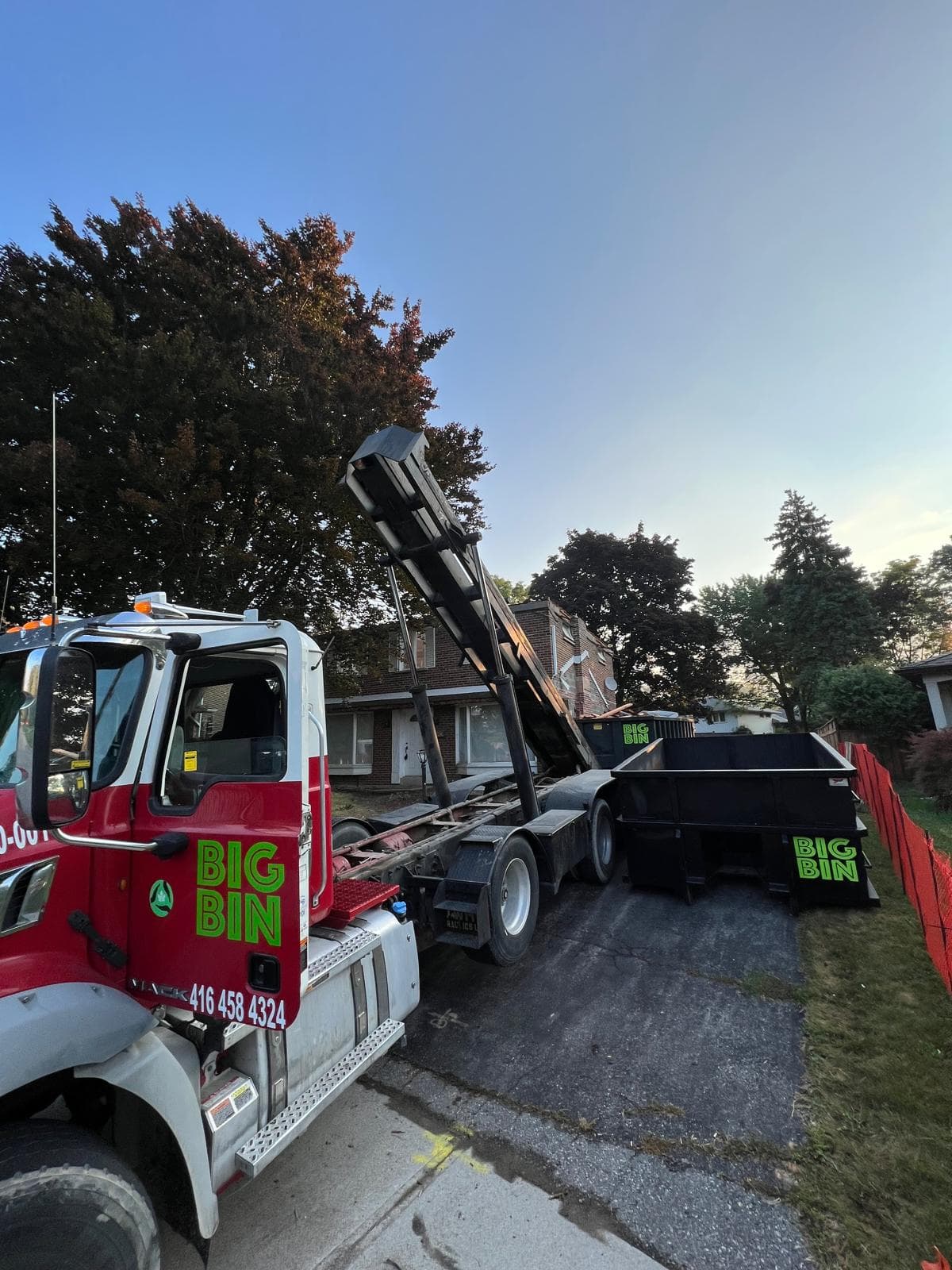
A bin is the other half on its own. Big Bin delivers a container, and it is filled by whoever is doing the work. The business supplies the bin and hauls the load. It does not break concrete out, and it does not load it.
So the question that settles it is whether the slab is already coming up. If a contractor is booked, or you are doing it yourself over a weekend, a bin is what is missing and it is the cheaper half. If nothing has been broken yet and nobody is going to, a container on the driveway does not move the job forward.
It is also common to want both, in that order. Plenty of people hire a breaker for a Saturday, do the work themselves, and need somewhere for the pieces to go on the Monday.
What a rental covers, and where the container can stand, is on Roll-off bin rental. If a bin is the half you need, Get a quote starts one.
Rebar, block and brick — what else can go in a concrete bin?
A receiving site sorts by what it can do with the material, not by what the material is called. Concrete, block and mortar are the same stream, and brick usually is. Reinforcing bar depends entirely on whether it is cast in or loose.
Reinforcing bar inside the concrete is normal and expected. It comes out at the crusher on a magnet, which is what the magnet is for. Loose steel is a different matter — offcuts, mesh sheets and stray lengths thrown in on top are scrap metal sitting in a concrete bin, and they are worth keeping separate.
Brick is the one most likely to catch somebody out, and it is a weight problem rather than a sorting problem. On the published figures brick is the heaviest material in the table above — heavier per cubic yard than concrete itself. Half a bin of brick can weigh what a full bin of something else does. The chart that figure comes from carries no publication date, so it is the weakest row on the page, and it is flagged that way wherever it appears.
Asphalt is the exception on that list, and the answer is flat rather than a matter of sorting. Asphalt is not a material Big Bin takes, in any bin size. Receiving sites do keep it as a stream of its own, and it is lighter than concrete for the same volume on the US EPA’s published conversion factors — the stone in it is held in bitumen rather than set in cement. That is where a driveway surface goes, not something to put in a bin here.
Soil is the other frequent passenger, because a slab usually has earth under it. That mixture has a measured figure of its own and its own set of trade-offs, which Soil and fill disposal sets out.

Not sure whether what is coming out counts as one load or two? Call 416-458-4324
What does concrete disposal cost, and how does the job run?
A clean concrete bin is not priced the way a renovation bin is, and the difference is the whole reason this section exists. The price buys one complete haul: the container is dropped, it is collected, and that is the job.
Nothing on a clean concrete load is weighed for billing. There is no tonnage in the price and no rate for going over one, so the scale ticket that decides a mixed-waste bill does not enter into it. What a bin costs sets out both products side by side.
What sets the limit instead is a painted line inside the container. Fill to the line and the price is the price. Carry a load above it and the overfill charge applies, which is the only thing that can move the number.
A tear-out is also usually one bin rather than a series. A driveway or a patio is a fixed quantity of material — you can measure it before anybody starts, which is not true of a renovation. So the job tends to be a single haul, planned once.
A second haul is a second complete cycle at the same price, which is the arithmetic to do before deciding whether one bin will hold it. The itemised list of what may be billed sits on Rental agreement and fees, and Get a quote prices your own job.
01
Tell us about the job
Call or email with what you are clearing, where a container can stand, and when you need it.
02
The bin arrives
A truck sets the container where you asked. Nothing is tipped on site: you or your crew fill it, on your own schedule.
03
It leaves full
The truck takes the whole container away, and the load crosses a scale at the receiving site.
Where does the concrete actually end up?
Clean concrete ends up as aggregate. It is tipped at a site with a crusher, broken down, screened into grades and sold back into construction as road base, backfill and bedding for pipes. Reinforcing bar is pulled out magnetically along the way and goes to scrap.
That is unusual. Most of what leaves a building site is being disposed of, and this is one of the few streams that is genuinely a raw material going somewhere useful — which is also the commercial reason a clean load is worth keeping clean.
Which sites do that work is a regional question with a published answer: each upper tier here licenses its own, and the gate rates differ enough that a load of rubble is priced quite differently from a load of rubbish. What nobody can give you is the other number — what share of what Big Bin collects comes back as aggregate rather than being buried has never been counted, and an uncounted recycling rate is a guess wearing a percentage sign.
For a particular load, Contact Big Bin and ask where it went. That answer exists even when the average does not.
What will your slab weigh?
Concrete is the row where the two published figures differ by more than two times, because loose rubble and packed slab are not the same cubic yard. The estimator shows both ends against your own dimensions, and it works from the space the broken material will occupy rather than the slab it was poured as.
Questions about a concrete load
How much does a driveway's worth of broken concrete weigh?
More than almost anyone expects, and you can work it out before you order. A single-car driveway of 12 feet by 24, poured four inches thick, is about 3.6 cubic yards of concrete — a small volume that would look lost in a large bin. On the published figures that same slab weighs roughly 1.4 to 3 tonnes. Double the driveway and you double it. Multiply length by width by thickness in feet, divide by 27, and the weight estimator turns the result into tonnes.
Can rebar stay in the concrete?
Reinforcing bar cast into the slab is normal and expected. It is pulled out magnetically at the crusher, which is what the magnet is there for, and it goes on to scrap from there. Loose steel is the part worth separating: mesh sheets, offcuts and stray lengths thrown in on top are scrap metal sitting in a concrete bin, not reinforcement in it. Call and ask before assuming a particular load is fine.
Does Big Bin break the concrete out, or just supply the bin?
It supplies the bin. Breaking a slab out takes a breaker or a saw, somebody to run it and the muscle to move the pieces, and that work is sold by demolition and excavation contractors rather than by a bin company. Big Bin delivers the container and hauls the load away; you or your contractor fill it. If the slab is already coming up, the bin is the half that is missing. If nothing has been broken yet, a container on the driveway does not move the job along on its own.
Why is a bin of concrete cheaper to tip than a bin of mixed waste?
Because the receiving site can sell what it makes from it. Clean concrete goes through a crusher and comes out as graded aggregate for road base, backfill and pipe bedding, so it is a raw material rather than something to be buried. Mixed waste has to be picked over or landfilled instead. The rate follows the outcome, which is also why one contaminated load loses the benefit entirely — the charge lands on the whole container. Call and we will tell you what a clean concrete load is charged at.
Can broken brick go in with the concrete?
Most receiving sites treat brick as the same stream as concrete, block and mortar, so it is usually not a sorting problem. It is a weight problem. On the published figures brick is the heaviest of these materials per cubic yard — heavier than concrete itself — so half a bin of it can weigh what a full bin of something else does. That single figure comes from a chart carrying no publication date, which makes it the weakest number here. None of which decides it, because Big Bin does not take brick in a clean concrete bin whatever the receiving site would do with it: a concrete bin here is broken concrete and nothing else. Brick goes in a mixed load instead, where the weight point above is the thing to watch — a mixed bin is priced with a tonnage included and a rate per tonne above it.
What happens to concrete after it is picked up?
A clean load is tipped at a site with a crusher, broken down, screened into grades and sold back into construction as road base, backfill and bedding for pipes. Any reinforcing bar is separated magnetically and goes to scrap. It is one of the few materials leaving a building site that is genuinely a raw material rather than waste. Which sites do that work is a regional matter and each Region here publishes its own; what has never been counted is the share of what Big Bin collects that comes back as aggregate rather than being buried, so you will not find a percentage quoted — call and ask where a particular load went.
Why can't I fill a 40 yard bin with concrete?
Because a 40 yard bin filled with slab would put the truck carrying it far past what it may legally weigh on the road. Multiply the published density by 40 cubic yards and the load alone runs into the tens of tonnes before the vehicle is counted. The constraint is arithmetic, not policy, and it is why heavy material is sold in small containers. Big Bin takes clean concrete and clean fill in the 14 yard.
Sources
Every fact on this page that is not simply how renting a bin works, and the public document it came from.
Source 1
Volume-to-Weight Conversions (document w-sw2-08)
Minnesota Pollution Control Agency — September 2021
Source 2
Volume-to-Weight Conversion Factors
United States Environmental Protection Agency, Office of Resource Conservation and Recovery — April 2016
Source 3
City of Woodland, California — no publication date printed; retrieved 2026-08-11
Reviewed August 2026Kenan Sljoka
Also on this site
Service
Soil and fill disposalService
Construction bin rentalService
Commercial bin and dumpster rentalService
Bin rental near youService
Dumpster rental
Useful things to read
Free tool
What does your debris weigh?Page
Bin rental for contractorsService area
Bin Rental in MississaugaService area
Bin Rental in BramptonService area
Bin Rental in OakvilleService area
Bin Rental in WhitbyService area
Bin Rental in OshawaService area
Bin Rental in Pickering
Tell us what is coming out
Give us the size of the slab and where a bin can stand, and we will tell you which of the three carries it. You or your contractor break it out and fill it. Get a quote asks for no email address. Every way to reach the business is on Contact Big Bin.