Guide
Roll-off bins explained
What the word describes, and how the truck gets a container on and off the ground. Which sizes exist, which of them Big Bin runs, and how full one can legally be filled — a limit set by the weight of the truck rather than the size of the bin.
- 5-Star Rated
- No distance charge
- 7 days included
- Order by 3PM, next-day delivery
Quick answer
What is a roll-off bin?
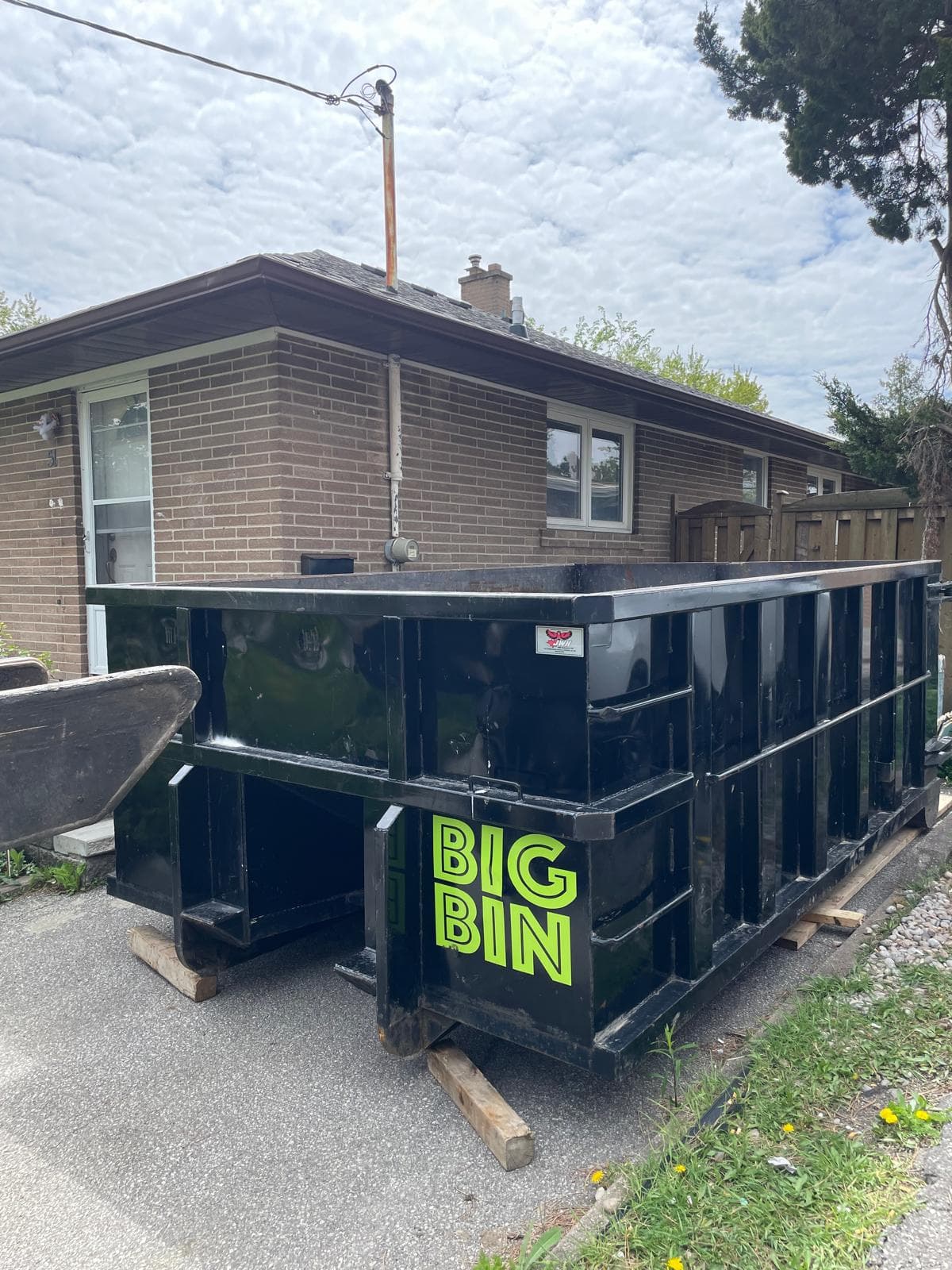
A roll-off bin is a large open-top steel container that a truck delivers by rolling it off the back of its bed on rails, then winches back on when the job is done — which is where the name comes from. Roll-off bins are measured in cubic yards, and Big Bin — our company — runs three sizes: 14, 30 and 40 yard. Because the container arrives and leaves on the truck rather than being tipped in place, it needs a clear, level run to sit on and enough overhead room for the bed to tilt. The free weight estimator answers the question a size cannot: what a full bin of a given material weighs.
Roll-off bins: the facts
- What it is
- An open-top steel container, delivered and collected whole on a truck
- How it is delivered
- The truck tilts its bed and the container rolls down rails onto the ground
- Measured in
- Cubic yards of volume — not weight, and not floor area
- Sizes Big Bin runs
- 14 yard · 30 yard · 40 yard
- Sizes Big Bin does not run
- 4, 6, 8, 10 and 20 yard — a job needing one of those needs another supplier
- What it needs on the ground
- 25 ft overhead, 10 ft wide, 65 ft of straight run
How does a roll-off truck load and unload a bin?
A roll-off truck does not lift a bin or tip it out. It sets the container on the ground and takes it away whole. The way it does that is the thing the bin is named after.
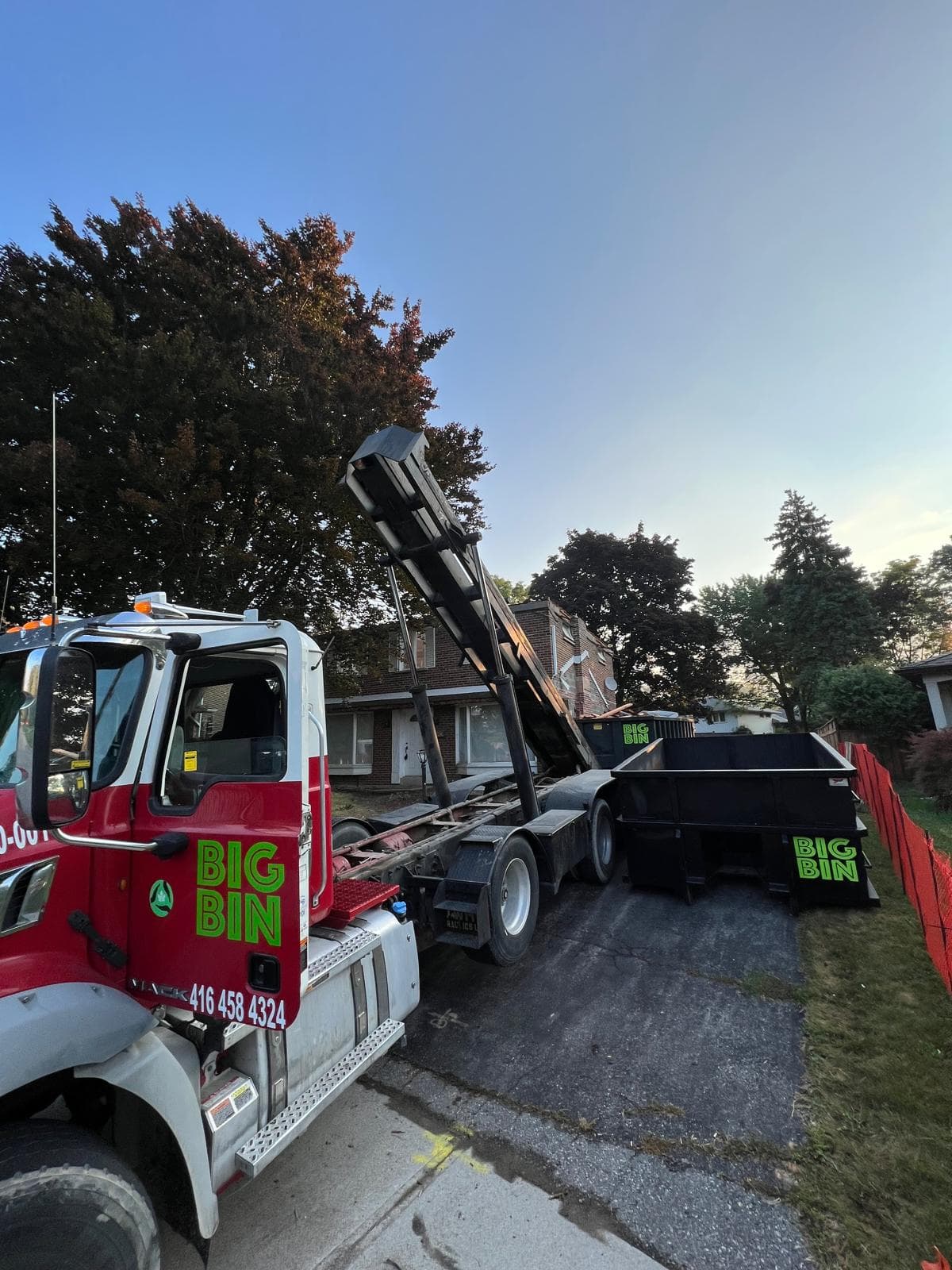
Delivering one runs like this. The truck backs into position with the empty container on its bed. A hydraulic hoist tilts the bed up at the back until the rear of the container touches the ground; on a long bin the front of the bed ends up well above the cab. The container then rolls down a pair of rails on small wheels at its back corners. It moves under its own weight, held by a cable or a hook on the hoist. The bed comes down, and the bin is standing where it was set.
Collection reverses it exactly. The bed tilts and the hook catches the container’s front rail. A winch then drags the loaded bin back up the rails onto the bed. Nothing is tipped out on site and nothing is transferred into the truck. The load leaves in the same box it went into.
Which is why the delivery needs more room than the bin does. The truck wants a straight run to back along, because the container rolls off in line with the bed rather than at an angle. It needs the height of a raised bed overhead — a good deal more than the height of the bin. And it needs ground that will take a container being dragged onto it, then the far greater load of that container full.
That mechanism is what separates a roll-off from the bins that get emptied where they stand. What a rental covers, and how the cycle runs, is on Roll-off bin rental.
What will a bin of this actually weigh?
Volume is how a bin is sold. Weight is what decides whether a load can legally be hauled at all, and on a mixed load what it costs to tip. The estimator applies published agency figures to your own dimensions. Its table gives the tonnes for a full bin of each material, at each of the three sizes.
What sizes do roll-off bins come in?
Roll-off bins are sized in cubic yards. The number is a volume: not a weight, and not the area it takes up on a driveway. A 20 yard bin holds twenty cubic yards of material. How much that weighs depends entirely on what the material is.
The market runs roughly 4 to 40 cubic yards. Big Bin runs three of those: 14, 30 and 40 yard. The other five are common, and a job that needs one is a job for a company that has it. A small heavy-material tear-out is far better served by a 6 or an 8 yard bin than by anything on this list.
What a rental of the three includes is on Roll-off bin rental. On a commercial site the size question turns on weight rather than volume, and that is worked through on Commercial bin and dumpster rental. Construction bin rental follows the same question through the stages of a build. For a slab or a driveway coming out, Concrete disposal shows why the smallest of the three is usually the right one.
Excavated earth behaves the same way, and it carries a set of provincial rules the other materials do not. Soil and fill disposal covers both. If you arrived here typing "dumpster" rather than "bin", Dumpster rental explains why the two words name the same container. For a size-by-size answer, including the ones Big Bin does not stock, see the Bin size guide.
| Size | What it suits | Big Bin runs it |
|---|---|---|
| 4 yard | A few cubic yards of heavy material — concrete, soil, a small tear-out | No — a job this size needs a different supplier |
| 6 yard | Small heavy-material jobs, and tight urban placements | No — a job this size needs a different supplier |
| 8 yard | A bathroom strip-out, or a modest volume of dense material | No — a job this size needs a different supplier |
| 10 yard | A single-room renovation, or a heavier garden clearance | No — a job this size needs a different supplier |
| 14 yard | A kitchen or bathroom renovation, a driveway tear-out, a garage clear-out | Yes — 4'1" × 11'6" × 7'6" |
| 20 yard | A mid-size renovation with bulky but light debris | No — a job this size needs a different supplier |
| 30 yard | A whole-floor renovation, a roof, a large clear-out | Yes — 5'4" × 20' × 7'6" |
| 40 yard | Light bulky volume — fit-outs, packaging, framing offcuts, commercial strip-outs | Yes — 7' × 20' × 7'6" |
Know which size you need? Get a quote
How much room does a roll-off bin need?
A delivery needs three things. Only one of them is the space the bin ends up occupying, which is the mistake that gets made.
The first is a straight run. The truck reverses into line with where the container will sit, because the bin rolls off along the axis of the bed. A driveway that turns, or one blocked partway down, is the common reason a delivery fails.
The second is overhead clearance, and it is the one people forget. The bed lifts to roughly the height of the container standing on end before anything moves. So low branches, hydro lines, soffits and garage overhangs matter as much as the width at ground level.
The third is a surface that will take it. A loaded container concentrates several tonnes onto small wheels and rails. It is dragged into place rather than set down gently.
A bin on the road rather than on private property needs municipal permission, at a fee the city sets. That is a separate question from the delivery. As things stand, applying is the customer’s job: Big Bin leaves the permit with whoever is renting the bin, and does not lodge it on their behalf. That is the arrangement today rather than a permanent rule, so it is worth confirming when you book. Whether the street belongs to the city or to the region changes which counter the application goes to as well. Not sure whether your placement needs one? Contact Big Bin before booking.
Big Bin publishes the measurements of its three containers, in the size table below. They outline the box, which is not the space a delivery takes: the bed lifts the container to roughly vertical and the truck needs a straight run to roll it off, so the room required is a measurement of the vehicle.
Allow roughly 25 feet of overhead clearance for the bed to lift, 10 feet of width, and 65 feet of straight run. These are guidelines with room in them rather than a specification — call and describe the spot if yours is tighter.
What our customers say
From our Google Business Profile, read on 2026-09-16
I would like to shout out these guys! Finding a waste disposal company that handles heavy materials like concrete without a bunch of hidden fees or headaches is usually very difficult but Big Bin made the process very easy. Pricing was great and the team was very professional. I would genuinely recommend them for any big project!
Ayman Khaled On time, quick and easy to communicate with, and great service all around
Eldin Malkic Amazing work ! Very good time that takes good care of you !
Evgeny Litvinenko
How full can a roll-off bin be filled?
A roll-off bin has two separate ceilings, and they are routinely confused. One is the fill line on the container. The other is the weight of the loaded truck on the road. On heavy material the second binds first, often long before the bin looks full.
The fill line exists because a load has to be secured. The Ontario Ministry of Transportation puts it plainly in its commercial vehicle safety requirements: it is the operator’s responsibility to ensure a load is properly secured and does not fall or become dislodged from the vehicle. The duty is set out in O. Reg. 363/04, adopted through Canada’s National Safety Codes. A bin heaped above its rails cannot be secured, so it cannot legally travel. That is why a driver will refuse one.
The weight ceiling is about the vehicle, not the container. Ontario sets what a commercial vehicle may weigh by its axle configuration — the number of axles carrying the load, and how far apart they are — under O. Reg. 413/05, Vehicle Weights and Dimensions. The Ministry’s guide to oversize and overweight vehicles and loads sets out when a vehicle above those limits needs a permit.
Now put that beside what materials weigh. On figures published by the Minnesota Pollution Control Agency and the United States Environmental Protection Agency, a 14 yard bin of broken concrete is already around 5 to 12 tonnes. Scale that up and the container stops being the constraint entirely, which is why the dense materials are sold in one size and the larger boxes are kept for light waste. What does your debris weigh? gives the figure for every material at each size. So on dense material the honest answer to "how full can it be" is a weight, reached well before the volume runs out.
Of those two ceilings, only the first has a number. Big Bin sets its line eighteen inches down from the rails, which puts it at 31" in the smallest container and 66" in the largest; above that a load cannot be secured, so it does not travel. The second ceiling turns on the truck’s axle configuration and its own empty weight, and that is a scale ticket rather than anything a page can publish.
Work out the weight before you pick the size
The estimator applies the published figures to your own load. Its table gives the tonnes for a full bin of each material at each size. No email address, no sign-up.
What does it cost to rent a roll-off bin?
A roll-off rental is not billed on a single shape. There are two of them, and which one you are buying is decided by what goes into the container rather than by the size of it.
Renovation and household waste takes the shape most people expect: a base price covering the container and the two truck trips, a quantity of weight included in it, and a per-tonne charge for anything above that quantity, read off the receiving site’s weighbridge ticket.
Clean rubble and clean fill are bought the other way round. One figure covers a whole cycle — the drop, the collection and the disposal — with no weight in the calculation at all. A painted line inside the container caps the load instead, and going above that line is the only thing that alters the figure.
Which of the two you have decides how to read a quote. On the first, an advertised number holds only while the load stays under the allowance, so a low base with a thin quantity can end up dearer on a heavy job than a fuller one. On the second there is nothing to exceed.
How a price is put together is on What a bin costs. Every charge that can appear on an invoice is on Rental agreement and fees. And Get a quote gives you the figure for your own job.
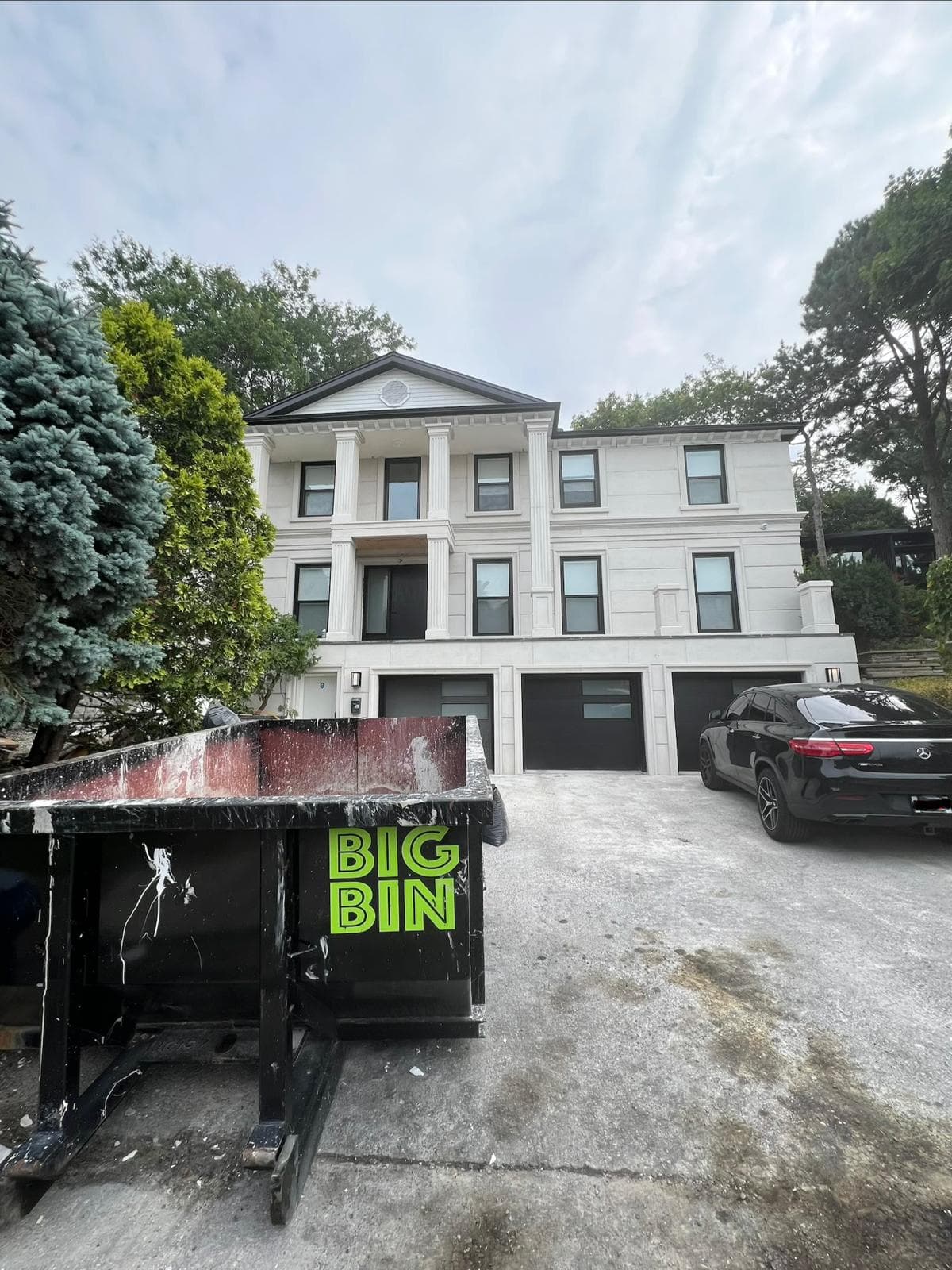
Can you buy a roll-off bin instead of renting one?
Roll-off containers are sold. For a business that fills one constantly and owns the equipment to move it, buying can make sense. For almost anybody asking the question, it solves less than it appears to.
The container is only half the equipment. A roll-off bin has no engine and no wheels that go anywhere. It is a box with rollers, designed to be dragged onto a specific kind of truck. Owning one still leaves you needing that truck: a hoist and matching rails to bring the bin in, take it away full, and get it to a facility that will accept the load. That is the expensive half, and it is the half a rental buys you.
So on a single project, buying a container adds a capital cost on top of the disposal you were going to pay anyway. It removes none of the logistics. The economics only turn over a long run of repeat work.
Big Bin rents bins and does not sell them. If a rental is what you need, Get a quote will start one.
Questions about roll-off bins
What does "roll-off" actually mean?
It names the mechanism rather than the container. The truck arrives with the bin on its bed, tilts the bed up, and the container rolls down a pair of rails onto the ground on its own wheels — it rolls off. Collecting it reverses that: the bed tilts, a cable or hook drags the loaded container back up the rails, and the whole thing leaves on the truck. Nothing is tipped out on site, which is the difference between a roll-off and the front-load bins that get emptied where they stand.
How much clearance does a roll-off truck need to drop a bin?
More than the bin itself takes up, and the overhead room is the part people miss: the truck has to raise its bed to roughly the height of the container standing on end before anything can roll off, so branches, wires and soffits matter as much as the width of the driveway. It also needs a straight run to back in along and ground that will take the point load of a loaded container. Call and describe where the bin has to stand, and we will tell you whether the truck can work it.
Is a roll-off bin the same thing as a dumpster?
In everyday use, yes — they are the same object under two names, and which word you use is mostly regional. "Dumpster" is the more common term in the United States and is widely understood in Canada; "bin" is the word the Ontario waste industry uses for the same container. "Roll-off" is more precise than either, because it describes how the container gets on and off the truck rather than what it looks like.
Can I buy a roll-off bin instead of renting one?
Roll-off containers are sold, but it solves less than it looks like it does. The container is only half the equipment: moving one needs a truck with a hoist and the rails to match it, so a bought bin still has to be delivered, collected and emptied by somebody who owns that truck. For a single project the purchase is a capital cost on top of the disposal you were going to pay anyway. Big Bin rents bins and does not sell them.
Sources
Every fact on this page that is not simply how renting a bin works, and the public document it came from.
Source 1
Commercial vehicle safety requirements
Ontario Ministry of Transportation — updated 31 July 2025
Source 2
Government of Ontario — no publication date printed; retrieved 2026-08-11
Source 3
Guide to oversize/overweight vehicles and loads
Ontario Ministry of Transportation — 2 July 2025
Source 4
Volume-to-Weight Conversions (document w-sw2-08)
Minnesota Pollution Control Agency — September 2021
Source 5
Volume-to-Weight Conversion Factors
United States Environmental Protection Agency, Office of Resource Conservation and Recovery — April 2016
Reviewed August 2026Kenan Sljoka
Useful things to read
Free tool
What does your debris weigh?Service
Roll-off bin rentalService area
Bin Rental in MississaugaService area
Bin Rental in BramptonService area
Bin Rental in OakvilleService area
Bin Rental in WhitbyService area
Bin Rental in OshawaService area
Bin Rental in Pickering
Renting one instead?
Tell us what the job is producing and where the bin needs to stand. We will tell you which of the three sizes fits it. Get a quote starts one. If you would rather work out the weight first, What does your debris weigh? runs in your browser and asks for nothing.