Roll-off bin rental
Bin Rental in PickeringFrom $650, before HST
Bins across Pickering, 14 yard, 30 yard and 40 yard, from the lakeshore streets to the rural north. The City charges its road permit per street rather than per application, which is the line most likely to be read wrong when a job needs a container round the corner as well as out front.
- 5-Star Rated
- No distance charge
- 7 days included
- Order by 3PM, next-day delivery
Quick answer
Who rents roll-off bins in Pickering?
Big Bin — our company — hauls roll-off containers into Pickering, from the lakeshore neighbourhoods up to the rural north and the conservation district at Whitevale. Three sizes are on offer: 14, 30 and 40 yard, for a stripped bathroom through to sustained site work. Delivery, collection and 7 days on site are included. A run to the far corner of the city is charged as a run round the block — no distance charge, no fuel surcharge, no environmental or admin fee, no agreement to sign. Order by 3PM and the container can be there tomorrow.
Why rent from Big Bin
The number you are quoted is the number you pay
Every charge that can ever reach an invoice is listed and explained before you book, not discovered afterwards. Tax is shown inside the figure rather than added at the end.
The same price across the whole delivery area
A job at the far edge of where Big Bin delivers costs what one round the corner from the yard costs. Distance changes the drive, not the invoice.
Order by 3PM, and a bin can be there the next day
That is a cut-off rather than an average, so it is something you can plan a job around. Whether a bin can reach you the same day you ring depends on how full that day already is, and that is a question for the call.
7 days included, and no contract to sign
The rental is the job, not a schedule you are joining. Keep the container longer and the extra days are priced and named; nothing renews and nothing has to be cancelled.
A real price without phoning for it
Postal code, material, size and your dates, and the figure comes back with the tax already in it — priced for your own days rather than for a typical week.
Bin rental in Pickering: the facts
- Rentals from
- $650, before HST
- Delivers to
- All of Pickering, from the lakeshore north to the concession roads
- Based in
- Mississauga, ON
- Bin sizes
- 14 yard · 30 yard · 40 yard
- Customers
- Residential and commercial
- Hours
- Monday to Friday, 6:00 am – 6:00 pm. Saturday, 9:00 am – 5:00 pm. Sunday, closed
- Phone
- 416-458-4324
- What a rental covers
- Delivery, collection and 7 days on site
- Weight on a mixed load
- An allowance that rises with the bin, then a rate per tonne at the scale
- Heavy material
- Clean concrete and clean fill go in the 14 yard, with no weight charge
- Getting a price
- Postal code, material and dates in the quote — about 30 seconds
- Mixed renovation waste
- Goes in the 14, 30 or 40 yard
- Clean concrete
- Goes in the 14 yard
- Soil or fill
- Goes in the 14 yard
- Not taken
- Asphalt is not a material Big Bin takes, in any bin size. Big Bin does not take contaminated soil. Clean soil and fill go in a 14 yard bin, wherever the job is.
- Roads the Region owns here
- Nineteen rows on the Region’s list name Pickering, covering eighteen streets
- Bin on a Pickering road
- A City road occupancy permit, applied for at least seven days ahead and charged for each street on it
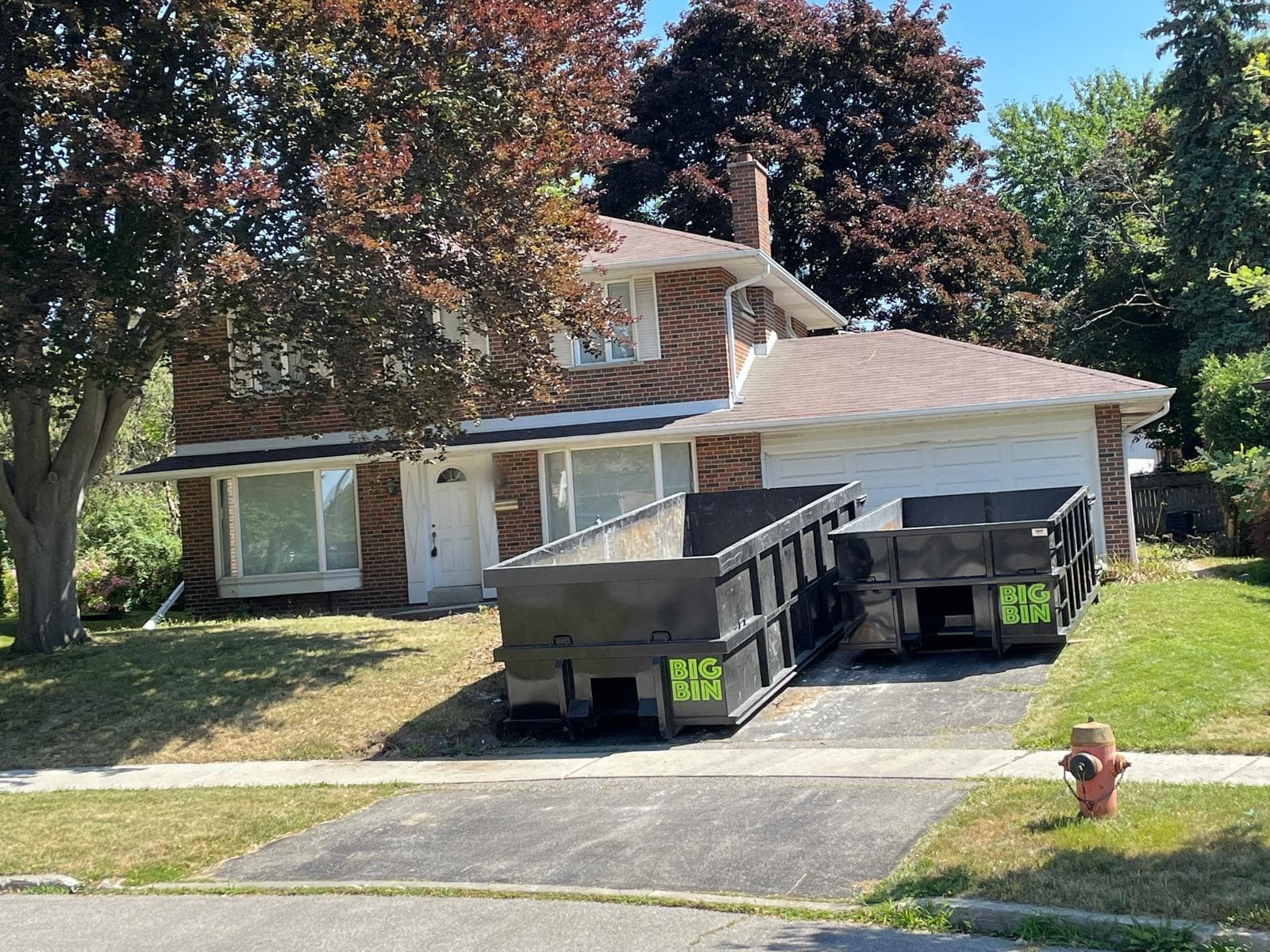
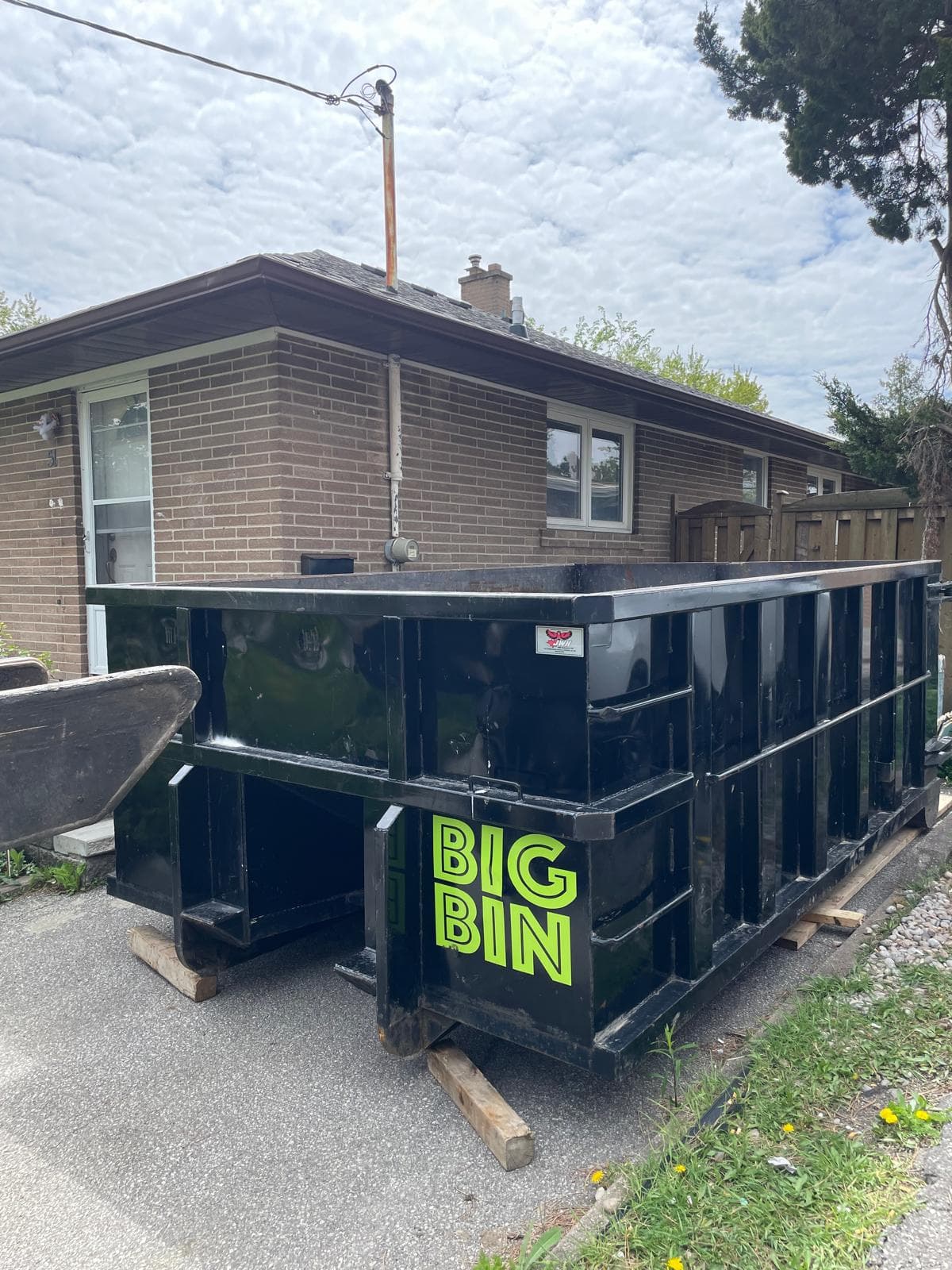
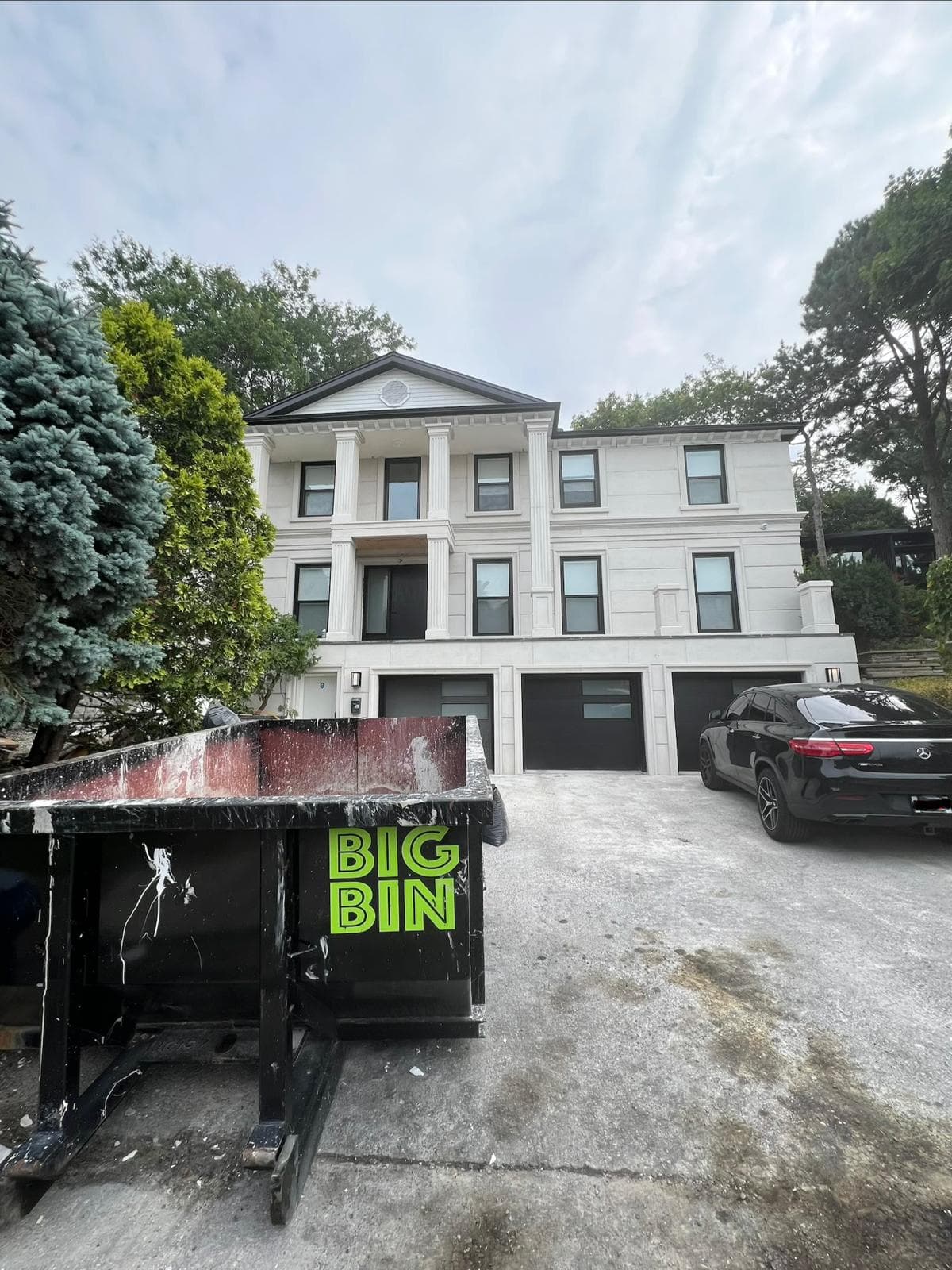
On the driveway, on planks
One of our own deliveries. The container is resting on wooden planks rather than directly on the driveway.
What Pickering customers say
From our Google Business Profile, read on 2026-09-16
I would like to shout out these guys! Finding a waste disposal company that handles heavy materials like concrete without a bunch of hidden fees or headaches is usually very difficult but Big Bin made the process very easy. Pricing was great and the team was very professional. I would genuinely recommend them for any big project!
Ayman Khaled On time, quick and easy to communicate with, and great service all around
Eldin Malkic Amazing work ! Very good time that takes good care of you !
Evgeny Litvinenko
Who owns the road outside a Pickering address?
One of two governments, and which one is on the public record rather than a matter of opinion. The City runs its own road occupancy permit for work on its road allowance; the Region of Durham runs a separate one on the roads it holds, with five business days asked for on a Regional road. On any job where the box will not be sitting inside a property line, that is the first thing to establish.
The Region settles it in a table anyone can open. It publishes a Regional Roads List carrying every road it owns, the municipality each one runs through, and the two points it runs between. Nineteen of those rows name Pickering, and they cover eighteen streets, because Ninth Concession Road is on the list twice under one number with a different pair of limits each time.
That doubling is worth a moment, because the two Ninth Concession Road rows are not the whole of Regional Road 5 in Pickering and the gap between them is not a gap. The Region lists Ninth Concession Road from the York Durham Line to Sideline 20; Central Street from Sideline 20 to Brock Road; and Ninth Concession Road again from Brock Road to Lake Ridge Road. Each row begins where the last one ended. One regional road, running unbroken, wearing a different street name for the middle stretch of it — and Regional Road 27 does the same trick round a corner, with Altona Road ending at Whitevale Road and Whitevale Road starting at Altona Road.
Which is why neither the number nor the street name is the thing to look up. The block is. An address on Brock Road sits on a row that runs from Montgomery Park Road as far as Regional Highway 47, a long way out of the city; an address on Whites Road sits on a row the Region measures from a point 0.65 km south of Oklahoma Drive, ending at Highway 7. And where a row carries on out of Pickering entirely, the reader who has just discovered they are the wrong side of a line wants the next town instead: Bin Rental in Ajax, Bin Rental in Whitby and Bin Rental in Oshawa carry the same table for the towns east of here.
| Road | The limits the Region prints | Regional road number |
|---|---|---|
| Alexander Knox Road | Peter Matthews Drive to Brock Road | 40 |
| Altona Road | Kingston Road to Whitevale Road | 27 |
| Bayly Street West/East | Whites Road to Lake Ridge Road | 22 |
| Brock Road | Montgomery Park Road to Regional Highway 47 | 1 |
| Central Street | Sideline 20 to Brock Road | 5 |
| Church Street | Bayly Street West to the eastern municipal boundary | 24 |
| Finch Avenue | Altona Road to Brock Road | 37 |
| Kingston Road West/East | Rouge River to Lake Ridge Road | Regional Highway 2 |
| Lake Ridge Road South/North | Bayly Street East/Victoria Street West to Thorah Concession Road 1 | 23 |
| Liverpool Road | Bayly Street to Finch Avenue East | 29 |
| Ninth Concession Road | York Durham Line to Sideline 20 | 5 |
| Ninth Concession Road | Brock Road to Lake Ridge Road | 5 |
| Peter Matthews Drive | 1.33 km south of Taunton Road to Whitevale Road/Alexander Knox Road | 28 |
| Seventh Concession Road | Westney Road to Brock Road | 31 |
| Taunton Road West/East | Markham-Pickering Townline Road to Highway 35/115 | 4 |
| Third Concession Road | Approximately 1.3 km West of Brock Road to Brock Road | 28 |
| Westney Road South/North | Harwood Avenue South to Seventh Concession Road | 31 |
| Whites Road | Approximately 0.65 km south of Oklahoma Drive to Highway 7 | 38 |
| Whitevale Road | Altona Road to Markham-Pickering Townline Road | 27 |
Not sure which of the two owns your block? Call 416-458-4324
What is involved in renting a container in Pickering?
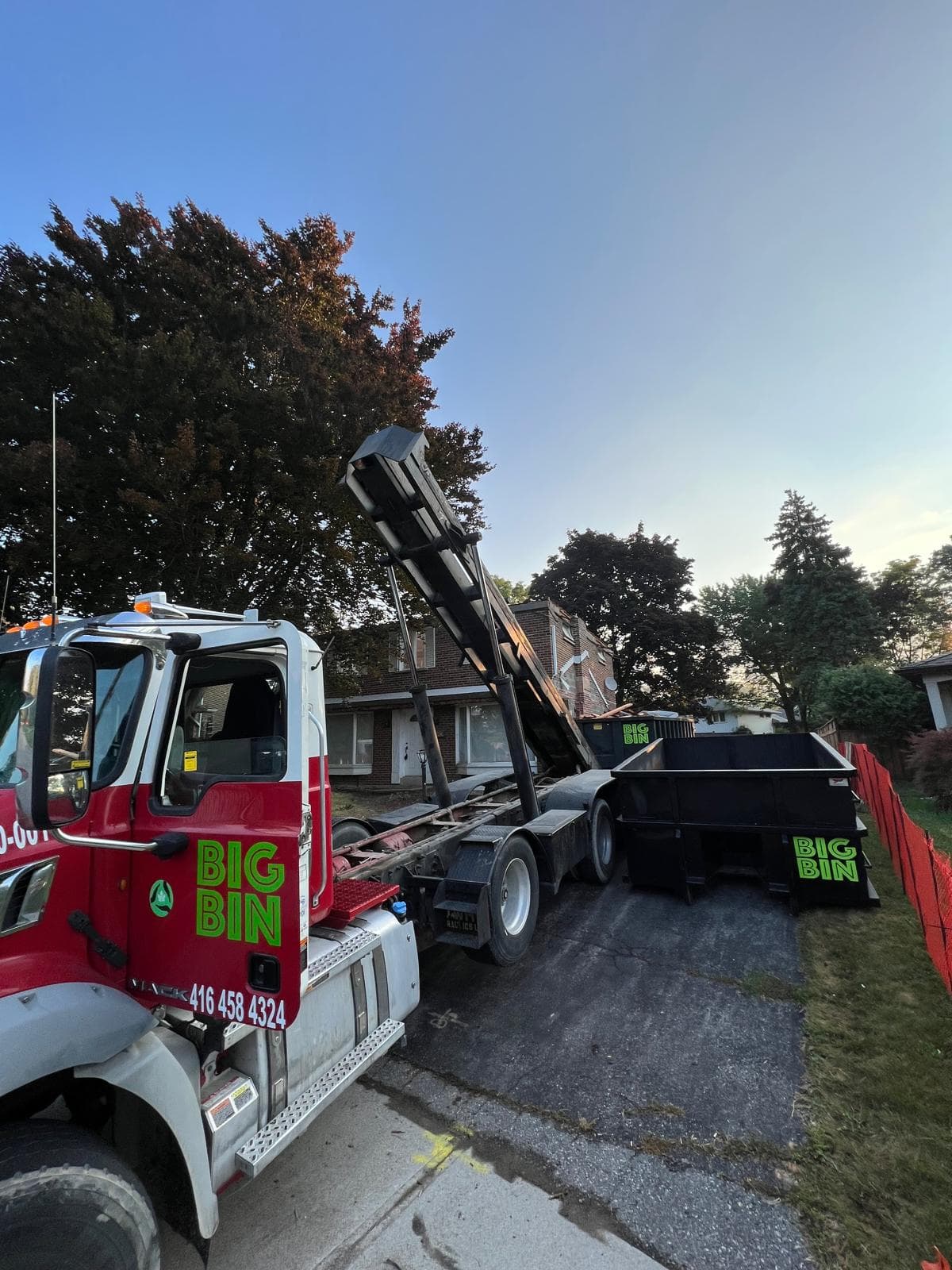
Three movements, and none of them needs you there. You describe what is coming out and point at a spot; a truck reverses in and lets the container slide down off a tilting bed; when the work is finished the same truck drags it back up loaded and drives away with it. Nothing is tipped out at the address and nobody loads it on your behalf.
Pickering is the near end of the Durham run. The yard sits at the other end of the service area — Bin Rental in Mississauga covers the western end of it, with Bin Rental in Brampton and Bin Rental in Oakville either side, and Roll-off bin rental is the whole of it in one place. That distance is a scheduling matter and not a billing one. Booking opens early: Monday to Friday, 6:00 am – 6:00 pm. Saturday, 9:00 am – 5:00 pm. Sunday, closed
01
Tell us about the job
Call or email with what you are clearing, where a container can stand, and when you need it.
02
The bin arrives
A truck sets the container where you asked. Nothing is tipped on site: you or your crew fill it, on your own schedule.
03
It leaves full
The truck takes the whole container away, and the load crosses a scale at the receiving site.
Where is a container allowed to stand at a Pickering address?
Almost always on the driveway, which is private land and therefore raises no permission question whatever. Whether one will take a container is about the run-up rather than the square footage: a truck needs a straight reverse, and the bed tilts high while the box rolls off the back of it. Roll-off bins explained walks through that movement, and Bin size guide gives the footprint each of the three takes up. Worth a walk to the kerb before booking: the service wire crossing the drive, any branch hanging over the entrance, and how low the garage header sits.
The strip between the drive and the kerb has an odd double status here, and the City states both halves of it plainly. The portion of your property nearest the street is municipal property and is known as a boulevard — and in the same breath, it is the property owner’s responsibility to maintain the municipal boulevard. The land is the City’s, the mowing is yours, and two of the rules attached to it reach a container directly: no rocks, bricks, concrete slabs or anything protruding, sharp or dangerous is permitted on a boulevard, and no person shall alter a boulevard by adding or maintaining any hard surface material, such as a widened driveway, without prior approval from the City.
So the hard standing a Pickering property has is broadly the hard standing it came with, and widening it outwards to make room is a request rather than a decision. That matters more than it sounds, because the fallback — standing the container out on the road allowance — is the slower and more expensive option by some way.
One part of Pickering narrows further still. The whole Hamlet of Whitevale is a heritage conservation district: By-law 4074/92 was passed by Council on 7 June 1993, designating the entire Hamlet of Whitevale as a Conservation District. Inside a district a heritage permit is required for new built elements in the landscape including fences or hard landscaping — walkways, driveways, parking pads. Read that next to the road table and the arithmetic of a Whitevale address is stark: a road carrying the hamlet’s own name is on the Region’s list, the ground in front of a drive cannot be hard-surfaced on a whim, and the container still has to stand somewhere.
What is left is the driver’s judgement, made at the kerb on the day, and a wasted trip is still a chargeable one. Describing the run-up over the phone is the cheaper half of that exchange.
| Where it stands | Whose land it is | What is involved |
|---|---|---|
| The driveway, inside the property line | Yours | Nothing at all |
| The boulevard, between the property line and the kerb | The City’s, though you mow it | A road occupancy permit, and no new hard surfacing without approval |
| A City street | The City’s | A road occupancy permit, charged for each street named on it |
| One of the nineteen rows above | The Region’s | The Region’s own permit, not the City’s |
| Anywhere inside the Whitevale district | Depends on the spot | The same, plus a heritage permit for any new hard landscaping |
What does Pickering ask for before a container stands on a City street?
One permit, and unusually the rule names the thing you are renting. Among the activities the City says require a road occupancy permit, alongside utility work and road closures, is the placement of moving containers, dumpsters or storage bins on the road or the boulevard. There is no interpreting to do and no by-law to stretch: a container on a Pickering road allowance is inside the rule as written.
The clock is the next thing. The City asks any resident, business or contractor to apply a minimum of seven days prior to occupancy for a regular permit, and ten days prior to a full road closure. Seven days is a full week of notice before a container may legally stand on a City street, and it runs end to end with whatever notice a hauler needs rather than alongside it.
Then the money, and it is charged on a basis no other municipality here uses. The permit is $175.00 (City of Pickering, no publication date printed; retrieved 2026-09-14) for each individual street named on the application — so a job that needs the container round the corner as well as out front is two charges on one form. Where the work cuts the asphalt there is a road degradation fee on top, at a minimum of $300.00 (City of Pickering, no publication date printed; retrieved 2026-09-14) or $45.00 per square metre (City of Pickering, no publication date printed; retrieved 2026-09-14) of cut. A container being set down does not cut a road, so that second line is the contractor’s problem rather than the householder’s — Bin rental for contractors is where the trade side of that sits.
And the insurance requirement is a corporate figure rather than a householder’s one. The City asks the applicant to carry $5,000,000 (City of Pickering, no publication date printed; retrieved 2026-09-14) of commercial general liability written on an occurrence basis, plus automobile liability on owned or leased vehicles, with the City of Pickering named as additional insured. The City asks the applicant to prove the cover by submitting a certificate it finds acceptable in all respects. Whose policy that is follows from who applies, which the paragraph below settles.
Nothing above applies on one of the Region’s own rows. There the Region’s permit governs, on the Region’s timetable. Two authorities, two applications, two windows — and applying at the wrong counter does not get corrected, it gets started again.
One thing this page cannot settle from City sources is whose name belongs on the application, and the answer is the customer’s. Big Bin does not lodge these for people as things stand, though that could change. It is worth reading beside the cover the City asks for, because five million dollars written on an occurrence basis is a contractor’s policy rather than something a householder is carrying already.
| What the City publishes | |
|---|---|
| Whether a container is named in the rule | Yes — moving containers, dumpsters and storage bins are listed |
| Notice on a regular permit | At least seven days before occupancy |
| Notice on a full road closure | At least ten days |
| The permit fee | $175.00 (City of Pickering, no publication date printed; retrieved 2026-09-14), for each street on the application |
| If the work cuts the road | $300.00 (City of Pickering, no publication date printed; retrieved 2026-09-14) minimum, or $45.00 per square metre (City of Pickering, no publication date printed; retrieved 2026-09-14) of asphalt cut |
| Liability cover required | $5,000,000 (City of Pickering, no publication date printed; retrieved 2026-09-14), City named as additional insured |
Where does a Pickering load end up?
Across a scale twice, and the gap between the two readings is the billable weight. What the load consists of then settles where each part of it goes next, and how much hand-sorting stands between it and wherever that is.
The Region’s own gates charge by weight and publish the numbers. They run Tuesday through Saturday and accept card or debit only. A load up to 40 kilograms is a flat $7 (Regional Municipality of Durham, no publication date printed; retrieved 2026-09-14); past that it is $1.40 (Regional Municipality of Durham, no publication date printed; retrieved 2026-09-14) per eight kilograms, which is nothing more than the per-tonne line underneath it cut into smaller pieces, $175 per 1,000 kilograms (Regional Municipality of Durham, no publication date printed; retrieved 2026-09-14). The line under that is the one that catches people. Fill and nothing but fill — the Region’s own enumeration reads soil, dirt, brick, gravel, rubble, sand, cement and concrete — is priced at $375 per 1,000 kilograms (Regional Municipality of Durham, no publication date printed; retrieved 2026-09-14), more than twice the general rate. So the neat, sorted, single-material load is the dear one here, which is worth knowing before a patio or a path comes out rather than after.
Pickering is the exception to all of that, and it is the Region’s own list that says so. The site it names in this city is a private one: only household hazardous waste is accepted free of charge on behalf of the Region, and all other waste is subject to the rates and hours posted by the operator. So the rates in the table below are not the rates at the nearest gate to a Pickering address. Anyone planning to run a few loads themselves should price the private site before assuming otherwise.
Earth is a category of its own here, and it starts at a threshold the City publishes in units a container is sold in. Any work involving the addition or removal of more than two dump truck loads, which the City puts at 20 cubic metres, may require a Fill and Topsoil Disturbance Permit. Twenty cubic metres is a little over twenty-six cubic yards, and soil travels in the 14 yard container — so one of them sits under the threshold and two of them sit over it, which is a question worth asking before the digger arrives rather than after.
On top of the municipal permit, soil off a Pickering property answers to the Province as well: it has to be characterised, its destination has to be recorded, and only certain sites may lawfully take it, set by the Ontario Ministry of the Environment, Conservation and Parks. So two identical boxes can be two unrelated jobs on the invoice. Soil and fill disposal spells that out, and Concrete disposal does the same for the rubble half.
| What arrives at the gate | What the Region charges | What it means for a rental |
|---|---|---|
| Up to 40 kilograms | $7 (Regional Municipality of Durham, no publication date printed; retrieved 2026-09-14) flat | A carload beats any container |
| Each eight kilograms above that | $1.40 (Regional Municipality of Durham, no publication date printed; retrieved 2026-09-14) | The tonne rate again, in smaller steps |
| General waste by the tonne | $175 per 1,000 kilograms (Regional Municipality of Durham, no publication date printed; retrieved 2026-09-14) | Weight is what the bill follows |
| Fill material and nothing else | $375 per 1,000 kilograms (Regional Municipality of Durham, no publication date printed; retrieved 2026-09-14) | Clean rubble is the dearest thing to be rid of |
Is the weight going to run out before the room does?
A container is sold by volume and hauled against an axle limit, so on anything dense the limit arrives first and the box never looks full when it goes. Feed the estimator the space your debris will take up and it hands back tonnes from published agency figures, early enough to change the order rather than explain the invoice.
Which container suits a Pickering job?
Three containers serve Pickering, and the same three serve everywhere else: 14, 30 or 40 yard. The interesting question is not which one but what each mistake costs, since the two directions are priced nothing alike.
Over-order and you have paid for air. Under-order and you have bought a whole second job — a delivery and a collection repeated, one more crossing of the scale, one more week parked on the drive. Which is why erring large is the cheap error and erring small is not. Heavy inert material is the one case where the decision is not yours: clean concrete and clean fill are restricted to the 14 yard and nothing larger, because a truck hits its axle limit on rubble while the box still looks half used. Construction bin rental covers the site version of the same decision, and Dumpster rental is the same three containers under the word most people search for.
Mixed work — a garage emptied out, one room taken to the studs, a roof stripped, a floor pulled up, a unit reset between tenants — carries no such cap, so capacity is the whole question and ordering short is the whole risk. One sheet of drywall thrown in on top of rubble also shifts a load from the capped list to the uncapped one, changing which boxes may be used and how the weight gets billed.
Working the weight out first answers both halves together, and does it before anybody has to stand in front of a heap trying to eyeball cubic yards.
| Material | Pounds per cubic yard, as published | Tonnes per cubic yard | Published by | What is being measured |
|---|---|---|---|---|
| Broken concrete | 860 – 1,855 | 0.39 – 0.84 | United States Environmental Protection Agency, Office of Resource Conservation and Recovery · City of Woodland, California | Slab, footing and foundation concrete, with or without reinforcing bar. The low figure is concrete as it turns up in a mixed waste stream; the high figure is a bin loaded with concrete and nothing else, which is what a driveway tear-out actually produces. |
| Soil, dirt and clean fill | 929 – 2,052 | 0.42 – 0.93 | United States Environmental Protection Agency, Office of Resource Conservation and Recovery · City of Woodland, California | Excavated earth. Moisture moves this figure more than any other on the page — the same soil after three days of rain can be a third heavier, and nothing on a website can tell you which you have. |
| Brick | 3,024 | 1.37 | City of Woodland, California | Whole brick. The heaviest thing per cubic yard on this page, and the figure most likely to catch somebody out: half a cubic yard of brick weighs more than a whole cubic yard of most other debris. Only one public figure could be sourced for it, and that document carries no publication date — treat it as the weakest row here. |
| Mixed renovation debris | 323 – 838.2 | 0.15 – 0.38 | Minnesota Pollution Control Agency | The ordinary contents of a renovation bin: wood, drywall, cabinets, flooring, packaging. Measured across 556 weighed truckloads, and two other agencies land inside this range — 417 lbs per cubic yard from the EPA and 484 from a Florida study of 171 weighed loads. |
| Demolition debris | 332 – 676.8 | 0.15 – 0.31 | Minnesota Pollution Control Agency | Whole-structure demolition rather than a renovation strip-out. Measured across 289 weighed truckloads. |
| Asphalt roof shingles | 731 | 0.33 | United States Environmental Protection Agency, Office of Resource Conservation and Recovery | Tear-off shingles. Heavier than most renovation debris and easy to underestimate, because a roof looks like a surface rather than a volume. |
The three containers in one table, against what each one takes. Bin size guide
What is knowable about a Pickering bill before the truck leaves?
Most of it, and the part that is not is the part worth estimating yourself.
The haulage half is fixed at booking. Container, material and days on site settle it, and on the two clean heavy streams that is the entire figure — both are priced as a completed haul with no weight component anywhere inside them, so the quote stands unless the container is filled above the line marked on its inner wall.
The permit half is fixed at a counter, is money paid to a government instead of to a hauler, and only arises where the container is headed out past the property line. In Pickering it is charged per street, which is the one place a reader is likely to under-estimate it.
The third settles at the scale house, some hours after the box has already left the address, and only a mixed load ever gets there: an allowance rides along with the rental, and every tonne past it is billed at the scale. That is the number no quote can contain, and the reason to work it out yourself beforehand. What does your debris weigh? turns tape-measure dimensions into tonnes. What a bin costs carries the single published figure and the conditions on it, Bin rental or junk removal? sets the whole arrangement against the alternative where somebody else does the lifting, and Get a quote prices an actual Pickering job, tax included.
Want the figure rather than the shape of it? Call 416-458-4324
What should be settled before a Pickering container is booked?
Four things, in an order, because each one narrows the next and taking them out of sequence is how a booking gets undone.
The spot comes first. Inside the property line nothing on this page applies and the date is yours to choose. Outside it, everything else follows.
Then whose road allowance it is, checked block by block against the nineteen rows above rather than by street name. That answer picks the office, and that office fixes how soon a container may lawfully turn up — seven days on a regular City permit, and the Region’s own window on a Regional road.
Then the contents, described as they actually are. Material decides which containers may be used at all and which half of the bill the job lands in. Describing a job as renovation waste and then filling the box with concrete and drywall together is the single most common reason a final figure lands as a shock. Bin rental near you and Commercial bin and dumpster rental cover the household and the business versions of that conversation.
The fourth cannot be settled from any document, because it asks about the company rather than about the city: what happens if the person driving pulls up, looks at the spot and says no. It is the only line here that has to be raised in conversation, and the price of skipping it shows up once a delivery fee is already spent.
Start with the spot
Give us the Pickering address, the spot you had in mind and a rough date. If the road allowance or the calendar will get in the way, that is far better established at the booking than at the kerb.
Bin rental in Pickering: common questions
Which roads in Pickering belong to the Region rather than the City?
Nineteen rows on the Region of Durham’s Regional Roads List name Pickering, and they cover eighteen streets: Alexander Knox Road, Altona Road, Bayly Street, Brock Road, Central Street, Church Street, Finch Avenue, Kingston Road, Lake Ridge Road, Liverpool Road, Ninth Concession Road, Peter Matthews Drive, Seventh Concession Road, Taunton Road, Third Concession Road, Westney Road, Whites Road and Whitevale Road. Ninth Concession Road accounts for the nineteenth row, because it appears twice. Every row carries a start and an end, so being on the list does not make a whole street the Region’s.
Is Ninth Concession Road in Pickering a Regional road along its whole length?
It is listed in two separate rows, and the stretch between them is Regional too under a different name. The Region lists Ninth Concession Road from the York Durham Line to Sideline 20, then Central Street from Sideline 20 to Brock Road, then Ninth Concession Road again from Brock Road to Lake Ridge Road. All three are Regional Road 5 and each row begins where the last one ended, so it is one continuous regional road that changes its street name for the middle stretch.
Do you need a permit to put a bin on a street in Pickering?
Yes, and Pickering is unusually direct about it. The City lists the placement of moving containers, dumpsters or storage bins on the road or the boulevard among the activities that require a road occupancy permit, so there is no by-law to interpret. On one of the Region of Durham’s roads the City’s permit does not apply and the Region runs its own. On your own driveway, inside the property line, neither applies and nothing is needed.
How far ahead do you have to apply for a road occupancy permit in Pickering?
At least seven days before occupancy for a regular permit, and at least ten days before a full road closure. The City puts that responsibility on the resident, business or contractor doing the work. Seven days is a full week of notice before a container may legally stand on a City street, and it runs end to end with whatever notice a bin company needs rather than alongside it, so the permit question is worth settling before a delivery date is chosen.
What does a road occupancy permit cost in Pickering?
The permit is charged for each individual street named on the application rather than once per application, which is the detail most likely to be read wrong — a job that needs the container round the corner as well as out front is two charges on one form. Where the work requires a road cut there is an additional road degradation fee, which the City quotes as a minimum charge or a rate per square metre of asphalt cut. A container on a driveway carries no fee, because no permit is involved.
What insurance does Pickering require for a bin on the road allowance?
Five million dollars of commercial general liability, written on an occurrence basis, plus automobile liability of not less than two million for all owned or leased vehicles. The City of Pickering must be named as an additional insured on the general liability policy, and the applicant has to verify the cover by submitting a certificate the City finds acceptable in all respects. It is a corporate policy rather than a householder’s.
Can I widen my driveway across the boulevard in Pickering to fit a bin?
Not without asking first. The City’s boulevard rules say no person shall alter a boulevard by adding or maintaining any hard surface material, such as a widened driveway, without prior approval from the City, and requests go through the Customer Care Centre. The same rules forbid rocks, bricks, concrete slabs or anything protruding, sharp or dangerous on a boulevard. So the hard standing a property has is broadly the hard standing it came with, unless the City agrees otherwise.
Who owns and who maintains the boulevard in front of a Pickering house?
The City owns it and the property owner maintains it. The City puts both halves plainly: the portion of your property nearest the street is municipal property and is known as a boulevard, and it is the property owner’s responsibility to maintain the municipal boulevard. That split is why a container standing on the strip in front of a drive is a road occupancy question rather than a private one, even though the person mowing it lives at the address.
Is there a heritage conservation district in Pickering?
One, and it covers a whole settlement rather than part of one. By-law 4074/92 was passed by Council on 7 June 1993, designating the entire Hamlet of Whitevale as a Conservation District. Inside a district a heritage permit is required for new built elements in the landscape, which the City’s own list spells out as including walkways, driveways and parking pads. A road carrying the hamlet’s own name is itself on the Region’s list of its own roads.
Do you need a permit to take soil off a property in Pickering?
Possibly, and the threshold is published in units that translate directly to a container. The Fill and Topsoil Disturbance By-law 6060/02 covers the removal or addition of fill or topsoil and changes to grading, and the City says work involving more than two dump truck loads — which it puts at 20 cubic metres — may require a Fill and Topsoil Disturbance Permit. Twenty cubic metres is a little over twenty-six cubic yards. Provincial rules on testing and tracking excess soil apply on top of that.
Where can a Pickering household take a small load of renovation waste?
Not to a Region of Durham gate inside the city, because there is not one. The Region’s own list does include a waste disposal site in Pickering, but it is privately operated: the Region says only household hazardous waste is accepted free of charge on its behalf, and all other waste is subject to the rates and hours the operator posts. So the Region’s published flat rate and per-tonne rate are not the rates at the nearest gate to a Pickering address, and a self-haul is worth pricing before the drive rather than after.
Sources
Every fact on this page that is not simply how renting a bin works, and the public document it came from.
Source 1
Regional Municipality of Durham — no publication date printed; retrieved 2026-09-14
Source 2
City of Pickering — no publication date printed; retrieved 2026-09-14
Source 3
Boulevard Maintenance, and Boulevard Maintenance By-law 6831/08
City of Pickering — no publication date printed; retrieved 2026-09-14
Source 4
City of Pickering — no publication date printed; retrieved 2026-09-14
Source 5
Fill and Topsoil Permits, and Fill and Topsoil Disturbance By-law 6060/02
City of Pickering — no publication date printed; retrieved 2026-09-14
Source 6
Road, Filming and Banner Permits
Regional Municipality of Durham — no publication date printed; retrieved 2026-09-14
Source 7
Waste Management Facilities: hours, locations, site fees and accepted materials
Regional Municipality of Durham — no publication date printed; retrieved 2026-09-14
Source 8
Ontario Ministry of the Environment, Conservation and Parks — updated 1 August 2025
Reviewed September 2026Kenan Sljoka
Also on this site
Service area
Bin Rental in MississaugaService area
Bin Rental in AjaxService area
Bin Rental in BramptonService area
Bin Rental in OakvilleService area
Bin Rental in OshawaService area
Bin Rental in Whitby
Useful things to read
Page
Bin rental for contractorsService
Commercial bin and dumpster rentalGuide
Roll-off bins explainedFree tool
Bin rental or junk removal?Free tool
Bin size guideService
Roll-off bin rentalFree tool
GuidesService
Construction bin rental
Ask about a bin in Pickering
Tell us what is coming out and where the container can stand, and we will tell you which of the three will carry it.